
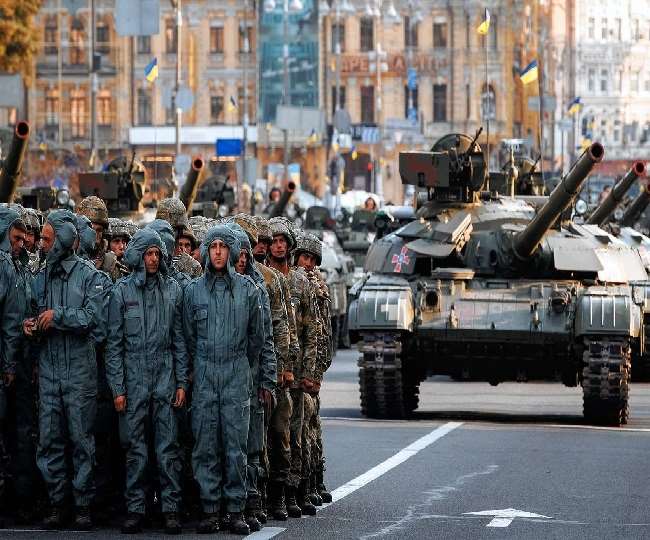
Kyiv/ Moscow | Jagran News Desk: The tensions between Russia and the West reached a new high on Tuesday following President Vladimir Putin's order to his forces to march into eastern Ukraine's two breakaway regions -Donetsk and Lugansk - after recognising them as independents.
In Putin's response, the United States (US) said it will impose more sanctions against Russia after coordinating with its allies. Meanwhile, Ukraine said it is "not afraid" of anyone, but urged Moscow to return to the table for negotiations.
Russia's conflict with Ukraine is not something new. The two on several occasions have had some heated debates since Ukraine gained freedom from the Union of Soviet Socialist Republic (USSR) in 1991. Following is the complete timeline of the main events in Ukraine's history since 1991:
1991: Leonid Kravchuk, leader of the Soviet republic of Ukraine, declares independence from Moscow. Later, he is elected as the first president of the country after a referendum.
1994: Kravchuk is defeated by Leonid Kuchma in elections.
1999: Kuchma is re-elected in a vote riddled with irregularities.
2004: Russia-backed candidate Viktor Yanukovich becomes president. However, this starts the "Orange Revolution", protests triggered by allegations of vote-rigging. Later, Viktor Yushchenko, a pro-Western former prime minister, is elected as president.
2005: Yushchenko assumes power and promises to lead Ukraine out of the Kremlin's orbit. Yulia Tymoshenko was also appointed as prime minister, but was sacked later.
2008: North Atlantic Treaty Organization (NATO) says Ukraine will one day become its member.
2010: Viktor Yanukovich beats Tymoshenko in presidential elections. Later, Russia and Ukraine clinch a gas pricing deal in exchange for extending the lease for the Russian navy in a Ukrainian Black Sea port.
2013: Yanukovich's government suspends trade and association talks with the EU in November and opts to revive economic ties with Moscow, triggering months of mass rallies in Kyiv.
2014: The protests, largely focused around Kyiv's Maidan square, turn violent. Dozens of protesters are killed. In February, parliament votes to remove Yanukovich, who flees. Within days, armed men seize parliament in the Ukrainian region of Crimea and raise the Russian flag. Moscow annexes the territory after a March 16 referendum which shows overwhelming support in Crimea for joining the Russian Federation.
Recommended For You
- In April, pro-Russian separatists in the eastern region of Donbass declare independence. Fighting breaks out which has continued sporadically, despite frequent ceasefires, into 2022.
- In May, businessman Petro Poroshenko wins a presidential election with a pro-Western agenda.
- In July, a missile brings down passenger plane MH17 en route from Amsterdam to Kuala Lumpur, killing all 298 people on board. The weapon used is traced back by investigators to Russia, which denies involvement.
2017: An association agreement between Ukraine and the EU opens markets for free trade of goods and services, and visa-free travel to the EU for Ukrainians.
2019: A new Ukrainian Orthodox church wins formal recognition, angering the Kremlin.
- Former comic actor Volodymyr Zelenskiy defeats Poroshenko in an April presidential election on promises to tackle corruption and end the war in eastern Ukraine. His Servant of the People party wins a July parliamentary election.
- US President Donald Trump asks Zelenskiy in July to investigate Joe Biden, his rival in the U.S. presidential race, and Biden's son Hunter over possible business dealings in Ukraine. The call leads to a failed attempt to impeach Trump.
2020 – Ukraine goes into its first lockdown to curb COVID-19.
– In March, IMF approves a USD 5 billion lifeline to help Ukraine stave off default during a pandemic-induced recession.
2021:
January - Zelenskiy appeals to Biden, now US president, to let Ukraine join NATO.
February - Zelenskiy's government imposes sanctions on Viktor Medvedchuk, an opposition leader and the Kremlin's most prominent ally in Ukraine.
Spring - Russia masses troops near Ukraine's borders in what it says are training exercises.
October - Ukraine uses a Turkish Bayraktar TB2 drone for first time in eastern Ukraine, angering Russia.
Autumn - Russia again begins massing troops near Ukraine.
December 7 - Biden warns Russia of sweeping Western economic sanctions if it invades Ukraine.
December 17 - Russia presents detailed security demands including a legally binding guarantee that NATO will give up any military activity in eastern Europe and Ukraine.
2022:
January 10 - US and Russian diplomats fail to narrow differences on Ukraine.
January 14 - A cyberattack warning Ukrainians to "be afraid and expect the worst" hits Ukrainian government websites.
January 17 - Russian forces start arriving in Belarus, to the north of Ukraine, for joint drills.
January 24 - NATO puts forces on standby and reinforces eastern Europe with more ships and fighter jets.
January 26 - Washington presents a written response to Russia's security demands, repeating a commitment to NATO's "open-door" policy while offering "pragmatic" discussions of Moscow's concerns.
January 28 - President Vladimir Putin says Russia's main security demands have not been addressed.
February 2 - The United States says it will send 3,000 extra troops to Poland and Romania to help shield NATO allies in eastern Europe from any spillover from the crisis.
February 4 - Putin, at Beijing Winter Olympics, wins Chinese support for his demand that Ukraine not be allowed to join NATO.
February 7 - French President Emmanuel Macron sees some hope for a diplomatic resolution of the crisis after meeting Putin in the Kremlin. Macron then visits Kyiv and praises the "sang-froid" of Zelenskiy and the Ukrainian people.
February 9 - Biden says "things could go crazy quickly" as the US State Department advises Americans in Ukraine to leave immediately. Other countries also urge their nationals to leave.
February 14 - Zelenskiy urges Ukrainians to fly flags and sing the national anthem in unison on February 16, a date some Western media say Russia could invade.
February 15 - Russia says some of its troops are returning to base after exercises near Ukraine and mocks Western warnings about a looming invasion. Russia's parliament asks Putin to recognise as independent two Russian-backed breakaway regions in eastern Ukraine.
February 18 - US ambassador to the Organization for Security and Cooperation in Europe Michael Carpenter says Russia has probably massed between 169,000-190,000 personnel in and near Ukraine.
February 19 - Russia's strategic nuclear forces hold exercises overseen by Putin.
February 21 - France's Macron says Biden and Putin have agreed in principle to a summit over Ukraine. The Kremlin says Putin will sign a decree recognising two breakaway regions in eastern Ukraine as independent entities shortly.
(With Reuters inputs)