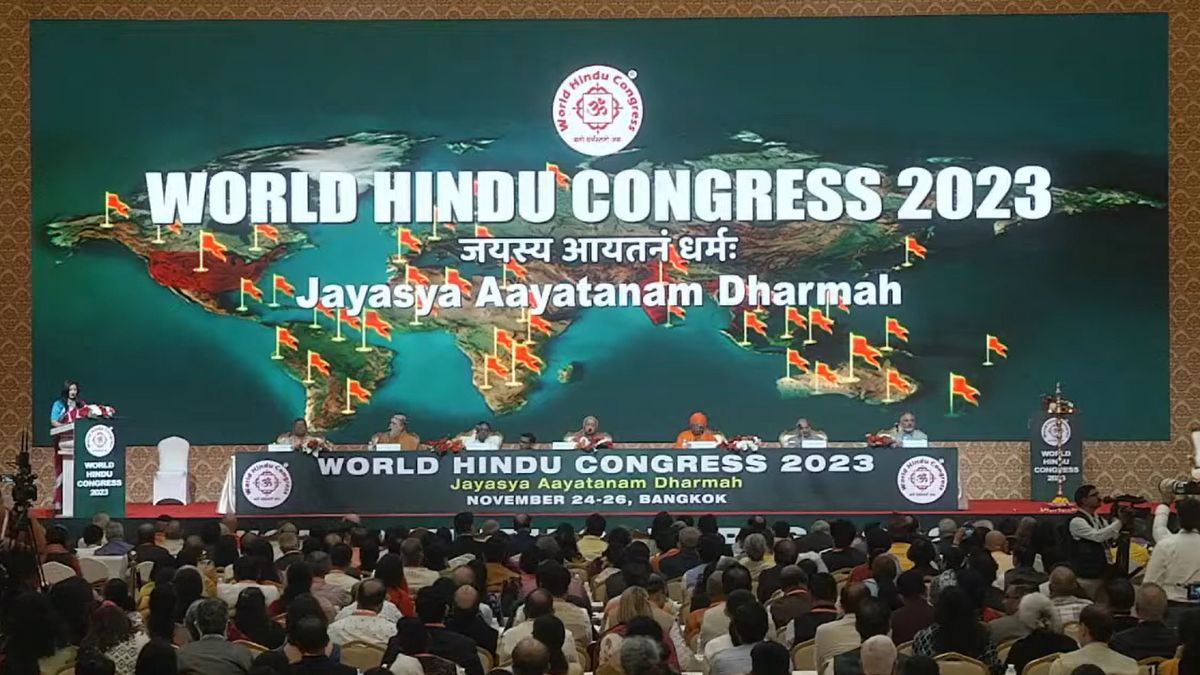
The World Hindu Congress being held in Bangkok on the second day adopted a resolution advocating the use of the term 'Hindu-ness' instead of 'Hinduism' when referring to the faith in English. The gathering commenced on Friday and saw participation from over 2000 delegates across 61 countries.
Stating that the term 'Hinduism' misrepresents the global Hindu community and their inherent goodness, the Congress adopted the declaration with an explanation. The resolution elaborates that within the phrase 'Hindu Dharma,' the term 'Hindu' is described as 'unbounded,' representing all that is 'Sanatan,' denoting eternal. The declaration further states, "The word 'Hindu' is followed by 'Dharma,' which means that which sustains."
"Hindu Dharma, thus, signifies all that which eternally upholds everything; an individual, a family, a community, a society, and even nature--both animate and inanimate," it states further.
"In contrast, Hinduism is totally different because it is suffixed with an 'ism'. The term 'ism' is defined as an oppressive and discriminatory attitude or belief. In the mid-nineteenth century, in the United States of America, the phrase 'the isms' was used to collectively refer to radical social reform movements and various non-mainstream spiritual or religious movements in a derogatory manner. The term 'Hinduism' should be understood in such a context," the declaration specifies.
Recommended For You
While describing the use of the word 'Hindutva', the resolution stated that it simply means Hindu-ness.
The history behind the use of the term 'Hinduism'
According to the resolution the term 'Hinduism' was first introduced into common usage by Sir Monier-Monier Williams through his handbook 'Hinduism,' published in 1877 by the Society for Promoting Christian Knowledge. This intellectually misleading terminology is identified as the origin of the negative anti-Hindu narratives spanning the past 150 years," the resolution observed.
"Due to these reasons, many of our elders favoured the term 'Hindutva' over Hinduism, as the former is a more accurate expression, encompassing the entirety of what the term 'Hindu' signifies. We align with their perspective and should adopt the same," it further stated.
The resolution gains significance in light of DMK leader and Tamil Nadu minister Udhayanidhi Stalin's critique of 'Sanatana' or Sanatan Dharma during a seminar in Chennai, where he compared it to "fever, malaria, dengue, and corona" and advocated for its abolition.
This comment sparked outrage from the BJP and seers, leading to demands for the DMK leader to retract his statements and issue an unconditional apology.