Women's Reservation Bill: The government tabled the 'Nari Shakti Vandan Adhiniyam' (commonly referred to as the Women's Reservation Bill) in Lok Sabha on Tuesday, which was the first day of business in the new Parliament building. The proposed legislation was introduced by Union Law Minister Arjun Ram Meghwal. The passage of the Bill will prove to be a triumphant move by the largest democracy in a world where the equal representation of women in electoral politics continues to be a largely unsolved issue. If the bill is passed by the Parliament, women will be entitled to 33 per cent of seats in Parliament and in state Legislative Assemblies.
Union Law Minister Arjun Ram Meghwal tables the Women's Reservation Bill in Lok Sabha. pic.twitter.com/CwKbbI6zpJ
— ANI (@ANI) September 19, 2023
According to the United Nations Entity for Gender Equality and the Empowerment of Women (commonly called UN Women), women constitute just 26.5 per cent of all members of single or lower houses of national legislatures across the world. The figure was 11 per cent in 1995. The rate of growth of female representation in national legislatures might seem impressive but UN Women estimates that achieving 50 per cent women representation in national legislatures is a long way to go and can only be achieved by 2063 with the current growth rate.
Only six countries have women as half or more than half parliamentarians in the lower houses of their legislatures. The said countries are Rwanda (61 per cent), Cuba (53 per cent), Nicaragua (52 per cent), Mexico (50 per cent), New Zealand (50 per cent), and the United Arab Emirates (50 per cent).
"Women hold 36 per cent of parliamentary seats in Latin America and the Caribbean and make up 32 per cent of parliamentarians in Europe and Northern America," says UN Women in a report published this year. While women occupy 26 per cent of parliamentary seats in Sub-Saharan Africa, the proportion is 18 per cent for Northern Africa, the report adds. In Europe and Northern America, female representatives make up 32 per cent of the strength of parliaments.
Few Countries With Reservation For Women In Parliament
Pakistan: Though a crisis-ridden state in other aspects, including women's safety, the country has a mandatory representation of women in the lower house of Parliament enshrined in its Constitution. Nearly 17 per cent of the seats in the National Assembly are reserved for female MPs. The lower house of the bicameral Parliament of Pakistan has 20.5 per cent women MPs at present. In contrast, India has only 15% female parliamentarians in Lok Sabha.
Bangladesh: India's neighbour in the East, Bangladesh has 14 per cent of seats reserved for women in its Parliament, the 'Jatiyo Sangshad'. Presently, the national legislature has 21 per cent female members. The 'Jatiyo Sanghsad' currently has a total strength of 350 MPs.
Zimbabwe: Currently, as many as 60 seats in the 280-seat lower house of Parliament are reserved for female representatives. The electoral quota system that guarantees the election of women to the National Assembly was included in Zimbabwe's new Constitution, which came into force in August 2013. According to the Inter-Parliamentary Union (IPU), which is a global organisation of national parliaments, women make up nearly 31 per cent of members in the southern African nation's National Assembly as of September 2023.
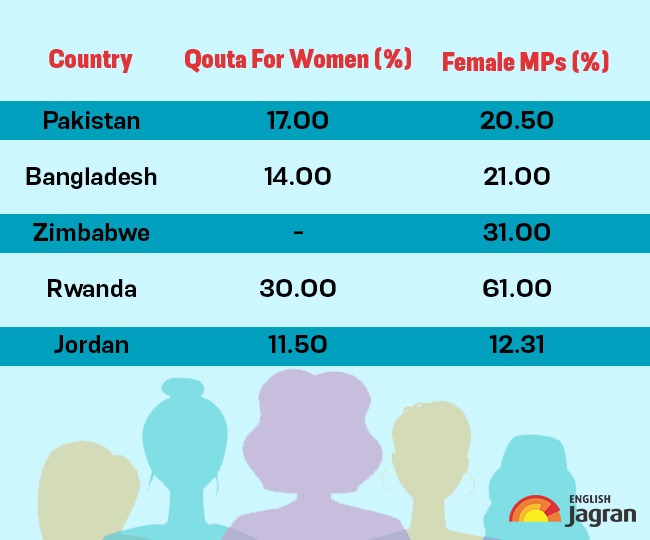
Rwanda: In 2018, UN Women in one of its reports described Rwanda as "the top country for women in politics". The present Constitution of Rwanda, which was adopted in 2003, sets a 30 per cent quota for women in the country's Parliament. Currently, as per figures published by IPU, the lower house of the Central African country's bicameral legislature has 61 per cent female MPs.
Jordan: The House of Representatives, which has a strength of 130 elected members, has 15 seats reserved for women. However, currently, the Middle Eastern country has only 12.31 per cent female MPs.
(With inputs from United Nations Entity for Gender Equality and the Empowerment of Women, and Inter-Parliamentary Union)