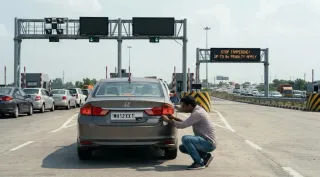
The Indian government is planning to make national highway toll booths barrier-free by February next year. However, the authorities are facing challenges from drivers who tamper with the vehicle registration plate to avoid the toll fee.
The Ministry of Road Transport and Highways (MoRTH) is now planning to change the national highway fee rules to allow the authorities to charge up to 8 times the normal toll fee as a penalty for vehicles with tampered number plates.
Barrier-Free Toll Plaza: What Is It?
Conventional toll plazas deduct toll fees by using a physical barrier, which stops vehicles, and the fee is deducted from the FASTag using the camera, or the vehicle owner pays through UPI.
This often creates long queues of vehicles at the toll plaza and interrupts the free-flowing traffic. The barrier-free toll collection system is based on Multi-Lane Free Flow technology, which detects vehicles and automatically deducts fees.
Also Read: Rakesh Roshan Brings Home A New Lexus LM350h Worth ₹3 Crore: Check Features And Specs
Barrier-Free Toll Collection: How It Works?
The barrier-free toll collection system uses an overhead frame that has sensors and cameras. The system also integrates FASTag with Automatic Number Plate Recognition (ANPR) technology.
The sensor detects the passing vehicle and uses high-performance AI cameras to read the number plate; meanwhile, the RFID sensors read the FASTag and automatically deduct the amount from the linked bank account.
If the FASTag of the vehicle is inactive or missing, the camera identifies the vehicle using the number plate and directly sends an e-notice to the owner.
Also Read: New Bajaj Pulsar 125 Neon Spied: New Entry-Level Model Incoming?
Barrier-Free Toll: The Challenge
To improve the flow of traffic on the national highways, the Indian government is planning to make toll collection barrier-free. However, several vehicle owners tamper with the vehicle registration plate to avoid toll payment.
The tampering of the vehicle number plate results in the failure of toll collection. Now, the government is planning to make changes to the fee collection rules to penalise such drivers.
Also Read: Maruti Suzuki Car Prices Hiked For The Fourth Time This Year: Check Details
Government’s Plan & Its Challenges
The government is now planning to use photographs taken at toll plazas. These images, along with vehicle information, will be analysed using AI to identify such vehicles.
It should be noted that the penalty, once implemented, will be different from the actions specified under the Motor Vehicles Act for tampered/illegal number plates. A ₹5,000 penalty for a first-time offence and a ₹10,000 penalty for repeat offences already exist.
While the government is planning to strengthen the barrier-free toll collection system, it has its own set of challenges. To begin with, the camera and sensors should be able to distinguish between intentional number plate tampering and a genuine problem.