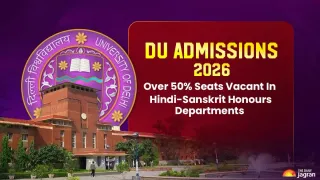
DU Admissions 2026: A significant shift in student preferences is being observed during the 2026 admission cycle at Delhi University, with over 50 percent of seats in traditional language courses remaining vacant. Across several campuses, departments offering Honours degrees in Hindi and Sanskrit are struggling to fill their allocated quotas. This sharp decline in enrollment has raised concerns among university faculty and academic experts, signaling a major shift in higher education priorities among both students and parents.
Educators attribute this rising vacancy rate to the Common University Entrance Test (CUET) admission process and evolving employment expectations. Instead of opting for traditional humanities subjects, candidates are increasingly choosing specialised streams directly linked to high-demand job markets. Consequently, unless changes are made to the admission process and course structures, language departments risk facing dwindling student participation.
ALSO READ: Pralhad Joshi Reviews Progress On Education Ministry Directives, Ongoing Initiatives
The Trend of declining enrollment in traditional language courses:
Data from Delhi University reveals that more than half of the seats for Hindi and Sanskrit Honours remain vacant in several institutions, particularly on the South Campus. For instance, at PGDAV Evening College, approximately 25 seats in Hindi Honours and 27 out of 54 seats in Sanskrit Honours have remained unfilled.
Teachers state that this widespread drop in numbers reflects a waning interest in the study of traditional Indian languages. Without direct intervention to boost student numbers, faculty members worry that language departments could face long-term academic setbacks and reduced funding in future admission cycles.
The impact of employment perceptions and skill-based options:
A primary reason behind this shift is the growing demand for market-relevant skills among modern undergraduate applicants. Courses focused on computer applications, management studies, media studies, and data analytics have gained popularity and now top the list of student preferences during college counseling.
Both applicants and their families view these technical and vocational programs as offering immediate employment opportunities compared to traditional language degrees. Due to this perception of direct career utility, traditional subjects like Hindi and Sanskrit have slipped down the rankings in candidates' preference lists during the allocation process.
Impact of the CUET admission process on subject selection:
Faculty members observe that the centralized allocation system under CUET has significantly altered how candidates choose their academic paths. Under this centralized system, students often prioritize highly-ranked professional courses or institutions over their preferred subjects, leading to a decline in the number of candidates opting for language courses.
Teachers note that the automated selection process makes it difficult for students with a genuine interest in languages- but who were not initially assigned high priority- to secure a seat. This exacerbates the issue of vacant seats across various colleges.
ALSO READ: UPTET Result 2026 Topper: Meet Azamgarh Headmaster Manoj Singh, Who Secures 149.267 Out Of 150 Marks
Faculty recommendations for improving the admission process:
In light of the ongoing issue of vacant seats, Delhi University teachers are urging the central administration to modify the existing admission policy for language departments. They have requested that individual colleges be permitted to issue their own cut-off marks and conduct direct admissions based on merit for these specific streams.
Faculty members argue that reintroducing merit-based entry for vacant language seats would provide a fair opportunity to candidates who wish to study Hindi or Sanskrit but missed out due to the CUET preference algorithm. This would ultimately stabilize enrollment numbers.