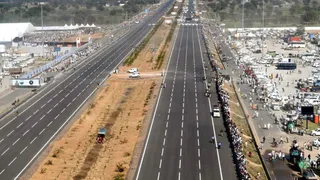
Bengaluru–Chennai Expressway Update: The much-awaited Bengaluru–Chennai Expressway is set to be delayed by two years due to technical and financial reasons. In a written reply, Union Road Transport and Highways Minister Nitin Gadkari informed the Lok Sabha that the project is facing several challenges in its third phase, especially in Tamil Nadu. However, Gadkari further clarified that except for a stretch between Arakkonam and Kancheepuram, all the remaining works are likely to be completed by the end of June 2026. The expressway is likely to boost the regional connectivity in three southern states—Karnataka, Tamil Nadu, and Andhra Pradesh.
While responding to a question by DMK’s South Chennai MP, Thamizhachi Thangapandian, the minister informed that the project is facing a contractor issue between Arakkonam and Kancheepuram. Gadkari further stated that the 71-km stretch of the project in Karnataka has already been completed; however, Phase 2 and Phase 3 in Tamil Nadu and Andhra Pradesh have witnessed delays due to multiple reasons.
Earlier last month, the ministry informed that the total estimated cost of both phases was about Rs 13,247 crore, adding that over Rs 9,126 crore has been spent so far. The ministry informed that while the physical progress in Andhra Pradesh stood at 87 per cent, the stretch in Tamil Nadu has witnessed 79 per cent completion.
The ministry stated that phase 3 has faced more challenges than the other two due to delays in approvals and construction challenges. It further informed that 92 per cent work has been completed at the Gudipala–Walajapet section; however, the project got delayed due to a delay in approval from the railways.
Apart from this, the Walajapet–Arakkonam stretch also witnessed 93 per cent progress, but it got affected due to delays in shifting power lines and railway buildings.