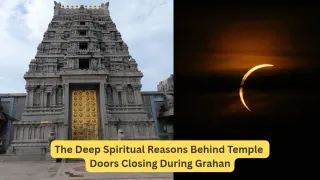
If you ever notice, during eclipses, solar (Surya Grahan) and lunar (Chandra Grahan) Hindu temples close their doors because eclipses are believed to disrupt the balance of cosmic energy. During an eclipse, negative or unsettled subtle energies temporarily diminish the divine idol's positive aura in the sanctum.
Closing the doors protects the deity's consecrated energy and prevents visitors from absorbing disturbed environmental vibrations.
Let's understand more about the ritual of closing temple doors and what activities are performed during this time inside the temple.
The Cosmic And Energetic Reason: Disruption Of Divine Vibrations
Hindu temples aren't just community halls. They carry acoustic and energetic power centres that surround the consecrated idol.
According to texts like the Dharma Shastras and Agamas, an eclipse represents an inauspicious period(Sutak) where normal worship is paused because the natural flow of sun or moon rays is blocked, creating stagnant energy.
Closing the heavy wooden or brass doors seals the pure energy inside the Garbhagriha and keeps out cosmic interference.
Temples carry acoustic and energetic power centres that surround the consecrated idol (Image: Pexels)
The Puranic And Scriptural Perspective
According to the legends, during Samudra Manthan, a demon took the form of a God to drink the amrit. But the Sun and the Moon caught him and informed Lord Vishnu, who killed that demon by beheading him. However, because he consumed the nectar, he became immortal and became the shadow planets Rahu and Ketu.
To get revenge on the Sun and Moon, Rahu and Ketu periodically swallow them, making the atmosphere unfavourable for standard ritual worship (Pooja).
ALSO READ: Why Do Devotees Offer Betel Leaves And Betel Nuts In Puja? Know Their Spiritual Significance
What Happens Inside The Temple Before, During, And After An Eclipse?
1. Sutak period(Preparation): Before the eclipse, puja rituals are paused, and doors are locked.
2. Use Of Tulsi leaves: After closing the temple gate, priests place sacred basil (Tulsi) over idols and food/water to protect them from negative energies. Tulsi's antibacterial and radiation-absorbing properties also help protect the idols and preserve the sanctity of the temples.
3. Post-Eclipse Purification (Samprokshanam): After the eclipse, the idols are washed with holy water. The priests energise the sanctum with Vedic chants and fresh flowers. After cleansing and purification, the temple doors are opened to devotees.
Before the eclipse, puja rituals are paused, and doors are locked (Image: Pexels)
Are There Any Exceptions?
All the holy places get closed during this period; however, Srikalahasti Temple in Andhra Pradesh stays open because the deity Lord Shiva is Vayu Lingam, believed to control Rahu and Ketu directly. Special Rahu-Ketu Pujas are conducted during the eclipse here.
Traditional Beliefs vs. Scientific Views
Eclipses involve changes in UV/solar radiation, gravitational shifts, and altered microbial activity that affect the eyes, while ancient rishis mapped these cosmic shifts to human bio-energies and prescribed isolation, meditation, and temple shutdowns during the peak hours.
ALSO READ: Karni Mata Temple: Why Thousands Of Rats Are Treated Like Royalty
This is why temple doors are closed during solar and lunar eclipses.
FAQs
1. What are devotees supposed to do during an eclipse if temples are closed?
Mantra chanting, fasting, meditation, and other prescribed activities and prayers are to be performed during the eclipse period.
2. Do all Hindu temples follow this practice?
No, not all Hindu temples follow this practice. One example is Srikalahasti Temple in Andhra Pradesh, which stays open during eclipses.