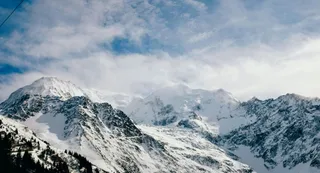
In the wake of the 2013 Kedarnath, 2021 Chamoli, and now the Dharali disasters, questions have resurfaced over the lack of effective glacier monitoring systems in high Himalayan regions. Taking a proactive step, the Wadia Institute of Himalayan Geology (WIHG) has initiated advanced monitoring measures in the Dhauli Ganga region, one of the most glacier-sensitive zones in Uttarakhand.
The institute has equipped the Dunagiri and Bagni glaciers with Automatic Weather Stations (AWS) and Automatic Water Level and Velocity Recorders, enabling 24-hour real-time monitoring of environmental changes. These instruments will record crucial data on temperature, rainfall, humidity, wind speed, solar radiation, glacier melt rate, snowfall, and water flow.
ALSO READ: Lucknow Electricity Defaulters Owe Over Rs 50 Crore; MVVNL To Begin Disconnections Post-Chhath
According to WIHG scientist Amit Kumar, these new automated systems will help bridge the long-standing data gap caused by inaccessibility and extreme weather conditions in high-altitude regions. “Continuous, real-time data will now allow accurate assessment of glacier mass balance, runoff patterns, and risks of Glacial Lake Outburst Floods (GLOFs),” he said.
The initiative forms part of WIHG’s broader campaign to shift from manual to automated glacier monitoring systems across the Himalayas. Earlier, the institute installed two radar-based and three automatic weather stations in the Bhagirathi basin to study altitude-dependent climatic variations. A similar network has also been established in the Nubra valley, originating from the Siachen Glacier in the Karakoram range, to monitor flood and lake outburst risks.
ALSO READ: India-China Flights Resume After 4 Years, Seen As ‘Major Step' Towards Restoring Normal Relations
In 2011, WIHG set up auto weather stations at the Chorabari and Dukrani glaciers. However, the Chorabari station was destroyed in the 2013 Kedarnath disaster and has not been replaced since. The Dukrani station remains operational.
With the latest installations in the Dhauli Ganga region, scientists hope to strengthen early warning systems and deepen understanding of climate-induced changes in one of the world’s most fragile ecosystems.