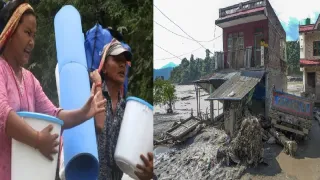
Nepal Flash Floods: For the 33,000 families displaced by the floods in Nepal, the issue is no longer limited to receiving relief. They have also begun to feel the need to raise their voice for their fundamental rights. The disaster, which has claimed over 1000 lives, made thousands of people homeless.
Rita Magar, a resident of Bange in Gajuri Village Municipality, Dhading District, raised her voice in Nepali, saying, "The Constitution requires that gas (food), baas (home) and kapas (clothes) are our fundamental rights. The government should ensure them."
Rita's home was destroyed in the August 26th flood. For the past six days, she has been living with her husband, two children, and father-in-law, Chhetri Bahadur Magar, at a relative's house in Gajuri. She and her father-in-law went to the Gajuri village municipality for relief supplies. They received rice, lentils, oil, and some other useful items, but they didn't know when their family would finally have a roof over their heads.
She said, "We're not asking the government for a house right now. If we could get some bamboo and a sheet of plastic, we could build ourselves a place to live. We wouldn't have to make the children sleep under the open sky."
'33,000 Houses Were Completely Or Partially Damaged'
According to government figures, 33,000 houses were completely or partially damaged in the Trishuli-Bhotekoshi floods. Some victims are in refugee camps in Kathmandu, Rasuwa, and Nuwakot, while most are sheltering with relatives and in public buildings. Rita's voice speaks volumes for affected families, demanding that safe housing be ensured as a right, beyond food and relief supplies.
Vinod Tamang of Betawati in Nuwakot said, "For a moment, it felt like life was in danger. When the water came rushing in at such a rapid pace, there was no time to recover. I managed to reach higher ground and save my life, but seeing my house destroyed before my eyes was heartbreaking."
Ritu Dangol said that since the flood, her two children have been unable to sleep at night out of fear. Sujan Ratna Acharya said, "Everything has been washed away, and now the biggest priority is finding shelter. We have no idea where to live or where to go."
Food and medicine are essential in the first 72 hours of a disaster, but after that, safe shelter becomes the most pressing need for displaced families. While the government's focus is currently on search and identification, provision of temporary settlements and safe housing is also essential for the families of the 33,000 affected households. Rita's voice connects this need with fundamental rights.
As evening falls, Rita, along with her children, retreats to a relative's doorstep in the Gajuri camp. The question before her isn't just about spending the night, but about a right she claims is enshrined in the Constitution.
With Inputs From Jagran Chief Reporter Vishwadeepak Tripathi.
You May Also Like To Watch: