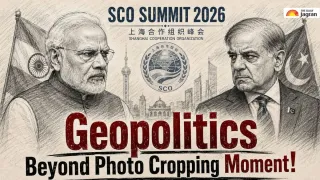
New Delhi/Ajeet Kumar: At the Shanghai Cooperation Organisation (SCO) Summit, Pakistan Prime Minister Shehbaz Sharif appeared in a family photograph alongside his Indian counterpart, Narendra Modi. However, the photograph released by his office deliberately cropped out the leader of the world’s largest democracy. This sparked a massive uproar on social media. Sometime later, the Pakistan PM posted the full-frame SCO group photograph that included PM Modi.
Pakistan's damage control mode
By then, however, the damage had already been done. But is photo-cropping the only incident worth highlighting? No. Geopolitics goes far beyond such acts, as seen when Sharif was later spotted desperately grabbing the hand of Russian President Vladimir Putin after the family photograph moment.
ALSO READ: Damage Control? Shehbaz Sharif Shares Full Pic After Pak PMO Crops PM Modi From SCO Group Photo
At SCO, India delivered bold message to Pakistan
At the event, the security-related decision assumes significance as PM Modi -- addressing the summit in the presence of Pakistani counterpart Sharif, Chinese President Xi Jinping and other leaders -- called on the grouping to confront countries using terrorism as an "instrument of state policy".
The prime minister urged the SCO to work unitedly to "dismantle the entire ecosystem" of terrorist financing, recruitment, radicalisation and safe havens and reject "double standards" in the fight against terrorism -- remarks widely viewed as a direct swipe at Pakistan.
"We must send a strong message to countries that use terrorism as an instrument of policy and provide safe haven and support to terrorists that terrorism can never be a strategic asset for anyone," PM Modi said.
Bishkek Declaration echoes India's concerns
Later, the same was reflected in the SCO Summit joint declaration. The member states termed the "double standards" in the fight against terrorism as "unacceptable" and called on the international community to combat the menace, including the cross-border movement of terrorists.
In a joint statement, called the ''Bishkek Declaration'', issued after the meeting of the Council of Heads of State of the SCO in the Kyrgyz capital, the member states expressed deep concern over developments in West Asia while condemning the US attacks on Iran.
The SCO member states strongly condemned terrorism in all its forms and manifestations and emphasised that "double standards" in the fight against terrorism are "unacceptable," said the joint statement signed by Prime Minister Narendra Modi, Chinese President Xi Jinping, Russian President Vladimir Putin and other leaders of THE SCO.
What Shehbaz Sharif said on India's terrorism charges
Responding to India’s charges, Sharif did not name New Delhi, and projected itself as the biggest victim of terrorism and claimed more than 90,000 lives have been lost.
Sharif said terrorism remained "one of the gravest threats that has affected our entire region in its various forms and manifestations". As chair of the SCO Regional Anti-Terrorist Structure, Pakistan has "worked actively to strengthen regional counter-terrorism cooperation," he said.
"In the past two and a half decades, we have sacrificed more than 90,000 lives and endured economic losses of over USD 150 billion in combating terrorism," he said.
Pakistan sought a peaceful and stable Afghanistan, he said, adding: "But let there be no ambiguity; so long as terrorists continue to use Afghan territory to shed the blood of innocent Pakistanis and other nations, lasting peace will remain beyond our reach."
What Sharif said on India's decision to suspend Indus treaty
Sharif also said that the region cannot "realise its full potential without lasting peace". "Water is the lifeblood of our region. It sustains millions of lives, nourishes our land and secures the very future of our coming generations," he said, highlighting the issue of the Indus Waters Treaty (IWT). Sharif stressed that it "must never be weaponised; it cannot be used as an instrument of coercion, nor can it ever be exploited for political leverage".
India decided to put the IWT in abeyance as part of a series of punitive diplomatic and economic measures unveiled soon after the Pahalgam terror attack in April last year that killed 26 civilians.
"The treaties governing our shared waters are solemn, binding international commitments. They are not matters of political convenience to be cast aside at your will. They must be honoured unconditionally, in both letter and spirit," Sharif said.
His remarks come a day after India rejected the Permanent Court of Arbitration''s order setting aside its decision to suspend the IWT with Pakistan, saying the "illegally-constituted" body has no jurisdiction to comment on New Delhi''s sovereign decisions.
Sharif's indirectly responds to India's concerns regarding Mecca Pact
Talking about the trilateral defence agreement between Pakistan, Saudi Arabia and Turkiye, named the "Makkah Defence Alliance", Sharif said the pact was "fundamentally defensive in nature and is neither directed against any state nor intended to create any confrontation or division whatsoever". He also called upon the international community to honour its commitment to "help the Palestinian people, alongside all other oppressed nations, secure their fundamental right to self-determination".
(With inputs from agency)
You may also like to watch