
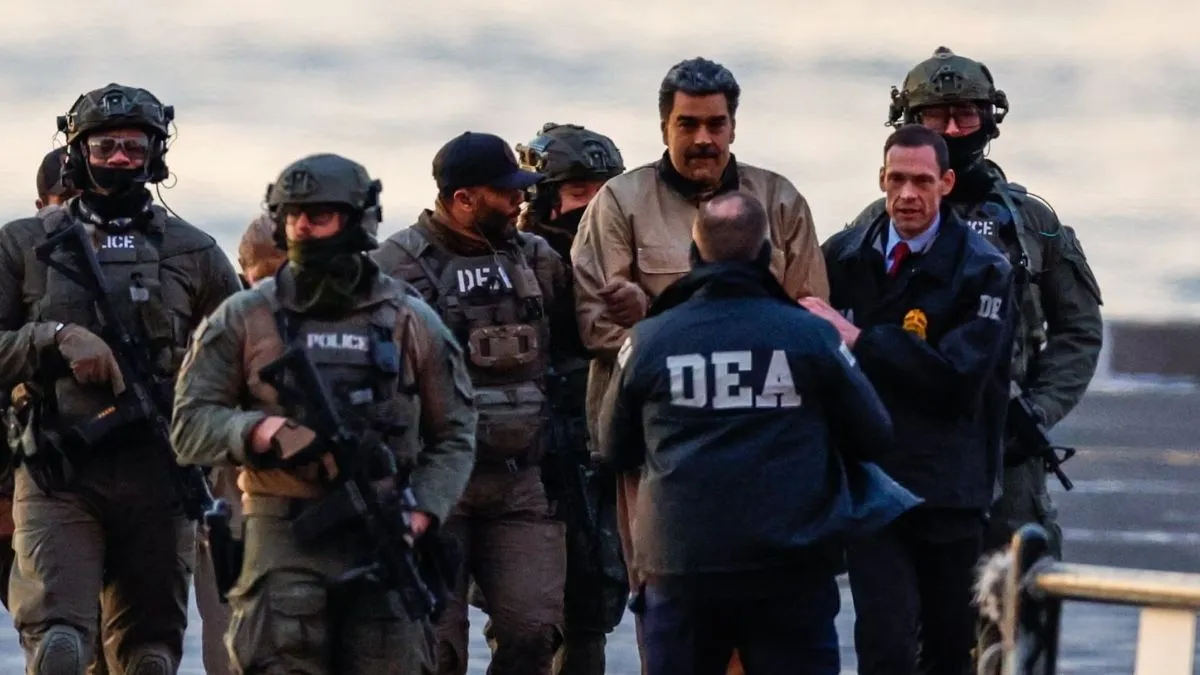
The unilateral military intervention by the United States in Venezuela on January 3 has stunned the world. For the first time, the Head of State of a country and his wife were picked up from the Presidential residence in the capital city by another country in a commando operation. While the US did not recognise Nicolas Maduro as the legitimate President, many countries, including India, did, and so did the United Nations.
The US defended its action as "law enforcement" because Maduro and his wife, Cilia Flores, were indicted by a New York court on charges relating to facilitating the flow of narcotics into the US. In such a situation, too, even a powerful country is not expected to conduct a military raid in a foreign country to catch a fugitive.
The US action to kill Osama bin Laden in Abbottabad, Pakistan, in May 2011 falls in an exceptional category. It cannot be considered a precedent for charges which have been levelled against Maduro and Celia Flores.
Venezuela's Vice-President Delcy Rodriguez has taken over as interim President. The US has pressured her to adhere to whatever it wants. This is especially in the area of oil and gas. Venezuela has the largest oil reserves in the world. Trump wants the US to completely control it. He also wants US oil companies and some European companies to get engaged in Venezuela's oil sector. He has made it clear that the US will not accept China and Russia having a role in Venezuela.
Recommended For You
US intervention in Venezuela is completely different from that undertaken by it in two other countries in this century -- Afghanistan and Iraq. Clearly, the US has learnt lessons from its failure in Afghanistan and its great difficulties in Iraq and is therefore avoiding them.
The US took military action along with Britain against the Taliban and Al Qaeda. There was global recognition that the US was justified in doing so. Al Qaeda's savage terrorist attack of September 11, 2001, was considered unacceptable by the international community. The military action led to the fall of the Taliban.
However, the US made the big mistake of not eliminating the Taliban and the Al Qaeda leadership. They escaped to Pakistan. The Taliban, with the support of Pakistan, launched an insurgency against the Afghan Republic, which was established with the US and NATO's assistance after the Taliban's defeat.
The US and NATO decided to assist the stabilisation of the Afghan Republic and also undertake nation-building. The UN authorised the creation of an International Stabilisation Force. However, the Republic and the US failed to defeat the insurgency, which continued for two decades. It led to the death of around 2500 US soldiers and an expenditure of about US$ 1 trillion.
Finally, it was Trump who drank the poisoned cup and entered into an agreement with the Taliban, which inevitably led to the collapse of the Afghan Republic. The US withdrew its forces from Afghanistan and the Taliban recaptured the country in August 2021. Twenty years of US effort had ended in failure.
The US formed a coalition of the willing to invade Iraq in March 2003 on the pretext that Saddam Hussein had weapons of mass destruction. The real object was to finish off Saddam Hussein and his Ba'athist regime. In its place, a "democratic" government was to be put in place. Saddam Hussein was deposed, found, tried and executed. The Ba'athists were removed from authority.
Soon, an Islamic, essentially Sunni, and Ba'athist insurgency began. It sucked in more US troops. By the time the US withdrew from Iraq in 2011, it had lost 4500 troops and spent US$ 2-3 trillion. Iraq continued to remain destabilised, and in 2013-201,7 the vicious Islamist group ISIS gained control of large areas of the country. Eventually, the US had little to show for its intervention.
Unlike Afghanistan and Iraq, the Venezuela intervention has been unilateral. Again, unlike the other two, Venezuela has no intention of sending ground troops. It has tightened the screws on Venezuela through a naval blockade, which has effectively choked the flow of any oil from the country. It has taken only one air operation, and Trump has announced that there does not seem to be a need for a second.
With the decision that no ground troops will be sent, it became inevitable that Venezuela be governed by Maduro's associates, but they will be remotely and completely controlled by the US. Venezuela will effectively, therefore, become a US colony.
While in Afghanistan and Iraq, the US lost its soldiers; in the Venezuela operation, no airman or special forces soldier died. While in Afghanistan and Iraq, the US spent around USD 3-4 trillion, it will make money in Venezuela. This is because it has decided to take over the oil and gas sector of the country. This is again a demonstration of Venezuela being reduced to a colony.
The naval blockade, which can choke Venezuela's economy, will prevent any section of the people from disturbing the political structure put in place now or arranged in the future by the US. In view of Trump's disdain for the rules of the current international order and the belligerent approach of his administration, there is no chance that any country or group of countries would be willing to go against the US. Yes, there will be a lot of grumbling and critical statements from the US's enemies and some from its allies too, but there will be no action against its interests by anyone.
The real issue now is whether other powers, such as China, will try to copy the US even if they do not have the great military capability of the US. That will push the world to anarchy, where the powerful will act in an unrestrained manner whenever they can.
(Note: The author is a former diplomat. Views expressed in the article are those of the author.)