
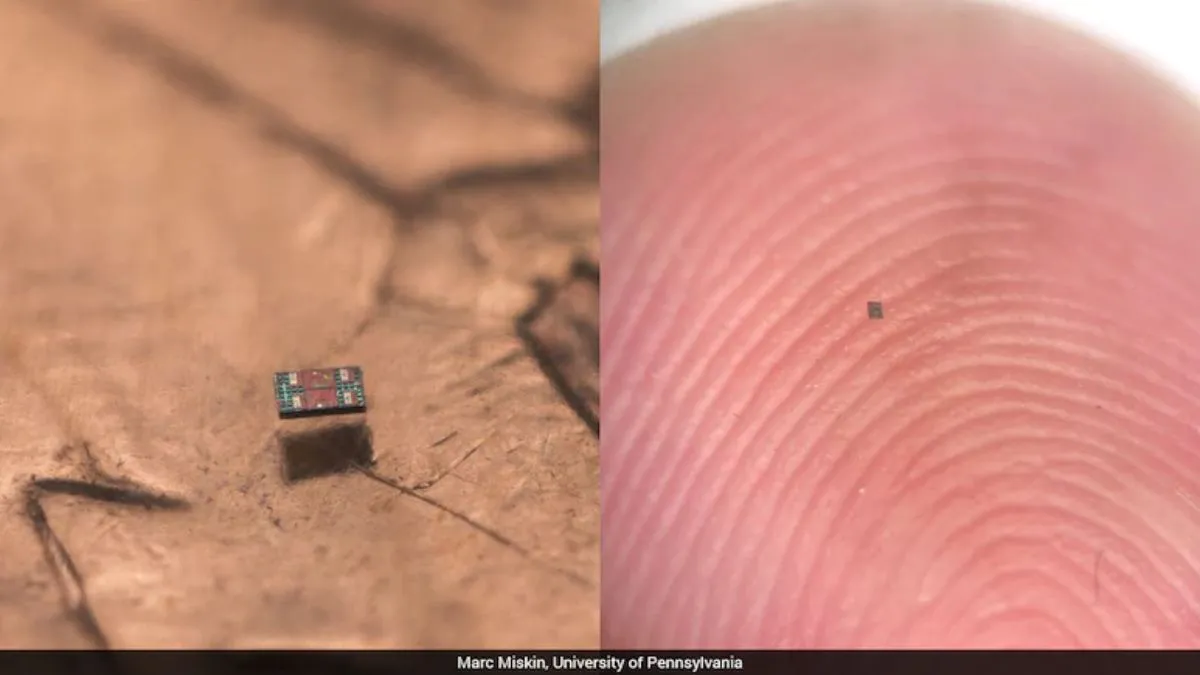
Robots are venturing into a territory once reserved for microbes. Researchers in the U.S. have unveiled the world’s smallest fully programmable, autonomous robots, so tiny they can sit on a fingertip without notice. Developed through a collaboration between the University of Pennsylvania and the University of Michigan, these microscopic machines can swim through liquids, sense temperature changes, make simple decisions, and run continuously for months powered only by light.
It’s a technical feat that combines motion, sensing, and computation at an unprecedented scale, but the implications go far beyond the lab. From medicine to environmental monitoring and micromanufacturing, these robots could work quietly, collaboratively, and independently in places humans cannot reach.
ALSO READ: Google Pay Partners With Axis Bank to Launch Flex, A UPI-Powered Digital Credit Card
Shrinking Robots to the Size of Microbes
For decades, robotics has advanced steadily in intelligence and capability, yet shrinking a robot to bacterial size was a challenge no one had fully solved. Electronics could get smaller, but enabling autonomous movement, sensing, and decision-making at microscopic scales remained nearly impossible.
Recommended For You
Measuring just 0.2 × 0.3 × 0.05 millimeters, these robots are firmly in the microbial world. At this scale, water behaves less like a fluid and more like a gel, making traditional swimming or propulsion useless. The team at Penn overcame this hurdle, creating a way for these tiny robots to move reliably through liquid, effectively opening an entirely new frontier in robotics, one where machines can operate in biological and chemical environments previously out of reach.
Moving Without Moving Parts
What’s remarkable is that these robots swim without any propellers, joints, or moving parts. At microscopic scales, mechanical components are inefficient and prone to breaking. Instead of pushing against water, the robots move the fluid around them.
They generate a small electric field that nudges charged ions in the surrounding liquid, and those ions pull nearby water molecules along, creating thrust that propels the robot. This electrokinetic propulsion is durable, allowing robots to operate for months without wear and tear. They are also easy to handle with laboratory tools like micropipettes, making them practical for real-world microscale applications.
Light-Powered Brains at Nano Scale
The brains of these robots come from ultra-miniaturised microprocessors developed at the University of Michigan. Each consumes a mere 75 nanowatts of power, about 100,000 times less than a smartwatch. Achieving this required compressing normal computing instructions into super-efficient commands tailored specifically for sensing and motion.
Most of the robot’s surface is covered with tiny solar cells, which power the robot and receive optical signals for programming. Each robot also carries a unique identifier, allowing researchers to address individual units even when operating in large swarms.
Sensing, Signalling, and Swarming
Far from passive, the robots include temperature-sensitive sensors capable of detecting changes as small as one-third of a degree Celsius. They can move toward warmer areas or signal changes with specific movements, reminiscent of the “waggle dance” used by honeybees.
When operating together, the robots coordinate their movements in patterns similar to schooling fish. This collective behaviour hints at swarms of robots capable of mapping temperature shifts, detecting chemical gradients, or monitoring biological environments autonomously.
Why This Breakthrough Matters
The potential applications are staggering. Each robot costs roughly a penny to make and can run independently for long periods, making it possible to deploy huge swarms simultaneously.
In medicine, they could navigate bodily fluids to monitor temperature, deliver drugs, or detect early signs of disease. In environmental science, they could track subtle changes in water quality or temperature at a level impossible for current sensors.
ALSO READ: Moto Edge 70 Launches In India With Snapdragon 7 Gen 4, 50MP Cameras And AI-Powered Photography
This tiny-robot revolution marks a turning point in robotics, bringing machines into spaces previously unimaginable, where invisibility, collaboration, and independence are essential.