
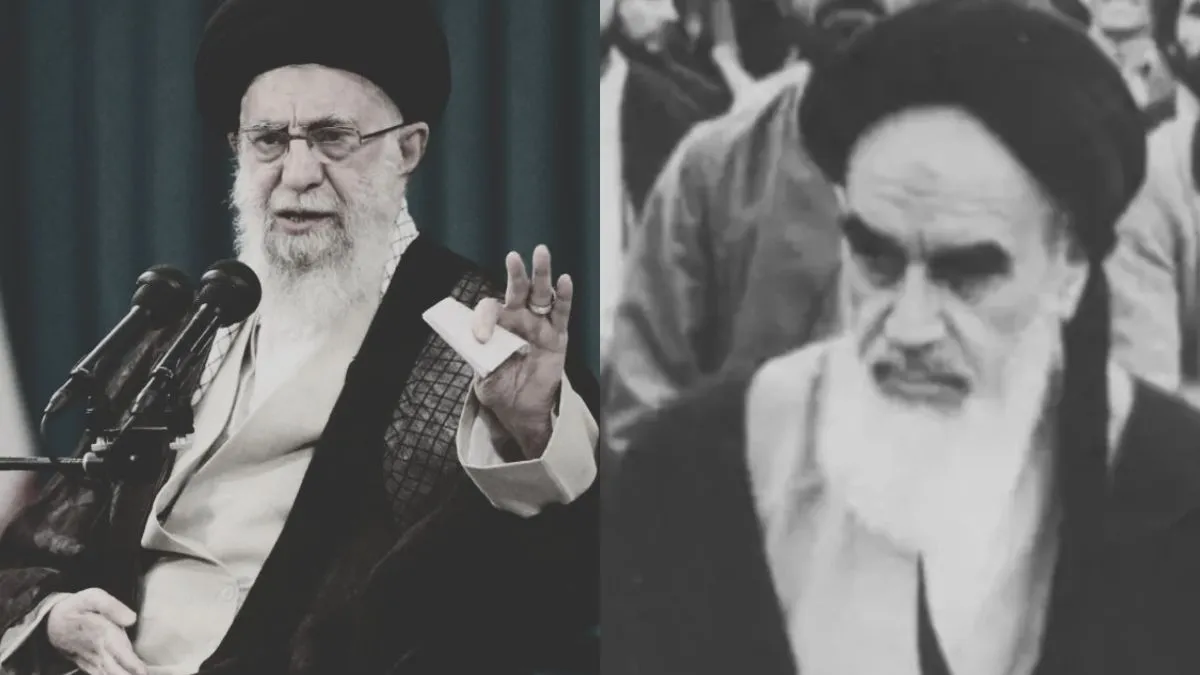
Khamenei Death: Iranian Supreme Leader Ayatollah Ali Khamenei was killed in a major attack by Israel and the United States, Iranian state media confirmed early Sunday, throwing the future of the Islamic Republic into doubt and raising the risk of regional instability.
In the aftermath of the leader's death, the Iranian government declared a 40-day mourning period. The attack also claimed the lives of four of Khamenei's relatives, including his daughter, grandchild, and son-in-law.
President Donald Trump announced the death hours earlier, saying it gave Iranians their "greatest chance" to "take back" their country.
According to state media, the 86-year-old leader was killed in an airstrike targeting his residence in the heart of Tehran. Satellite imagery from Airbus revealed that the site had been heavily bombed.
However, did you know that Iran's Supreme Leader, Ayatollah Ali Khamenei' s grandfather has a secret connection to India?
Iran-Israel War Tensions: Iran's Supreme Leader's Secret Connection To Indian Roots
Long before the 1979 Iranian revolution, before Khamenei or even Ayatollah Ruhollah Khomeini, the founder of the Islamic Republic, there was a boy born in a town called Kintoor.
Kintoor, a small village in the Barabanki district of Uttar Pradesh, is far from the political turmoil of the West Asian region. However, in the early 1800s, it was the birthplace of Syed Ahmad Musavi, a devoted Shia cleric born to a family that had migrated from Iran to India a generation earlier. Known as Sayyid Ahmad Musavi Hindi, he was also referred to as the "Hindustani Mullah" in the UP region and was the grandfather of Ayatollah Ali Khamenei.
Recommended For You
Kintoor has long been a center of Shia scholarship, and Musavi's influence would extend far beyond this small town. After some time, Sayyid Ahmad moved to Najaf in Iraq before settling in Khomein, Iran, in 1834, marking the start of his family’s religious and political journey. Despite settling in Iran, Musavi retained the 'Hindi' title throughout his life, a nod to his Indian roots, which is still recorded in Iranian documents today.
Musavi is believed to have played an important role in shaping Khamenei’s spiritual path. During a time when the British East India Company was tightening its control over the Indian subcontinent and Mughal influence was on the decline, Ahmad Musavi's journey began. In 1830, he left Kintoor for Najaf, Iraq, to visit the tomb of Imam Ali, and he never returned.
ALSO READ: Iran In Turmoil: Will Khamenei's Son Mojtaba Become Next Supreme Leader? How Is The Successor Chosen
What started as a pilgrimage turned into migration. Within a few years, Musavi settled in the Iranian city of Khomeyn, where he married, raised children, and integrated into the Iranian clerical society. Yet, he never abandoned the title "Hindi," a lifelong reminder of his Indian origins. Reports note that this title, "Hindi," remains in Iranian records to this day.
Ahmad Musavi passed away in 1869 and was buried in Karbala. His religious legacy, including his teachings and vision of faith, lived on, shaping not only his descendants but also the foundation of Iran’s statehood.
One of Ahmad Musavi's grandsons was Ruhollah, born in 1902. Ruhollah Khomeini would later become the father of Iran’s Islamic Revolution and its first Supreme Leader. By the 1960s, Khomeini had emerged as a staunch critic of the Western-backed Shah Mohammad Reza Pahlavi and the aggressive secularisation of Iranian society.
Ayatollah Khomeini led the Iranian Islamic Revolution, overthrowing Mohammad Reza Pahlavi, the pro-Western Shah of Iran, in 1979. This event marked the establishment of the Islamic Republic of Iran, and Khomeini went on to become its first Supreme Leader, a position he held until his death in 1989.
The remnants of Sayyid Ahmad Musavi's ancestral home can still be found in Kintoor, where villagers remember his contributions with pride. Locals maintain that the roots of contemporary Iran trace back to India. Historical accounts show that Sayyid Ahmad moved from India to Iraq during the 19th century, which later became his home in Khameneh, Iran. This migration would eventually give rise to Ayatollah Ruhollah Khomeini, the leader of the 1979 Islamic Revolution, and his successor, Ayatollah Ali Khamenei, who became the Supreme Leader of Iran.