
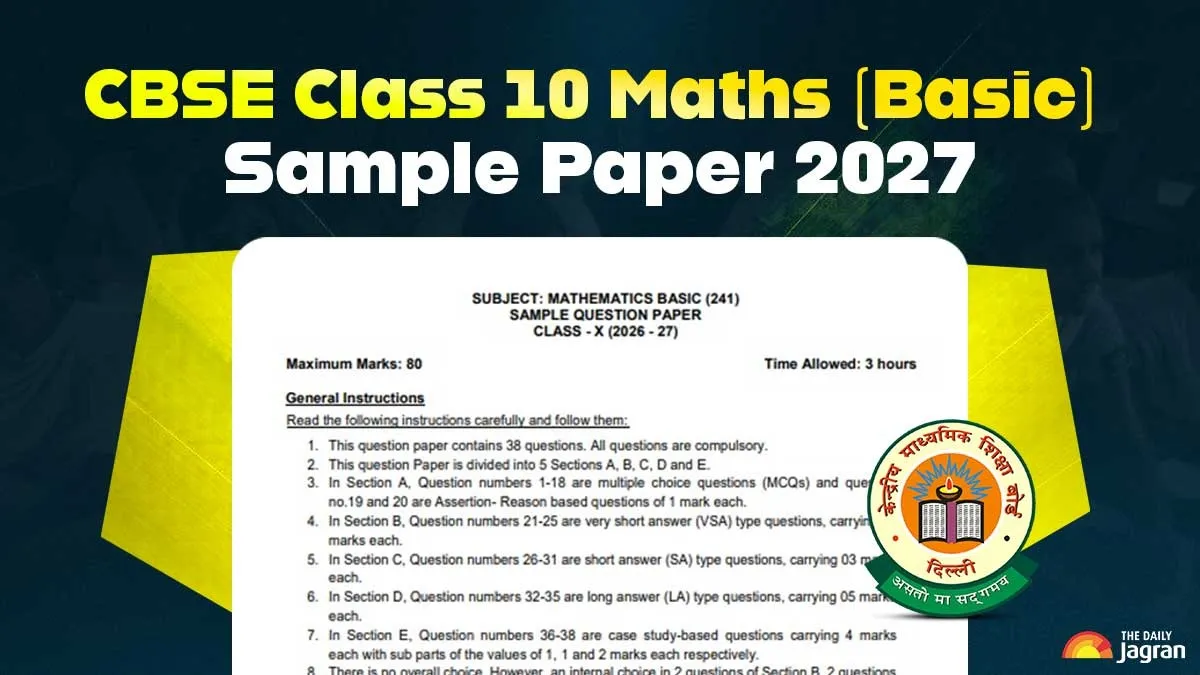
The Central Board of Secondary Education (CBSE) has released the Class 10 Sample Question Papers (SQPs) and Marking Schemes for the 2026-27 academic session. Students preparing for the CBSE Class 10 Board Exams 2027 can access the official Mathematics (Basic) Sample Paper and its corresponding marking scheme through the CBSE Academic website.
The official CBSE Class 10 SQP page includes separate links for Mathematics (Basic) as well as Mathematics (Standard). These sample papers familiarise students with the question design and help them understand the assessment pattern ahead of the board examination.
Key Highlights Of The CBSE Class 10th Maths Sample Paper:
Particulars | Details |
Board | Central Board of Secondary Education |
Class | Class 10 |
Subject | Mathematics (Basic) |
Subject Code | 241 |
Academic Session | 2026-27 |
Board Exam | CBSE Class 10 Board Exam 2027 |
Sample Paper | Available |
Marking Scheme | Available |
Official Website | cbseacademic.nic.in |
Paper Pattern And Section-Wise Structure:
The paper contains 38 compulsory questions divided into five sections.
Section A (Q1-20) has 20 MCQs and Assertion-Reason questions worth 1 mark each, totaling 20 marks.
Section B (Q21-25) has 5 very short answer questions of 2 marks each, totaling 10 marks.
Section C (Q26-31) has 6 short answer questions of 3 marks each, totaling 18 marks.
Section D (Q32-35) has 4 long answer questions of 5 marks each, totaling 20 marks.
Section E (Q36-38) has 3 case-study questions of 4 marks each, totaling 12 marks.
There is no overall choice, though internal choices are provided in select questions across sections.
Direct Link To CHECK: CBSE Class 10 Maths (Basic) Sample Paper 2026-27
How To Use The Sample Paper For Preparation?
Students are advised not to simply read through the paper but to attempt it as a full-length mock exam- setting a timer and solving it without referring to textbooks or notes, then comparing answers against the official marking scheme afterward.
Benefits Of Practicing Sample Papers
-Helps students understand the exact exam pattern, question types and marks distribution before the actual board exam
-Builds time-management skills by simulating real exam conditions with a timer
-Allows students to identify calculation errors, formula mistakes and conceptual gaps through self-evaluation against the marking scheme
-Boosts confidence and reduces exam-day anxiety by making students familiar with the paper format in advance