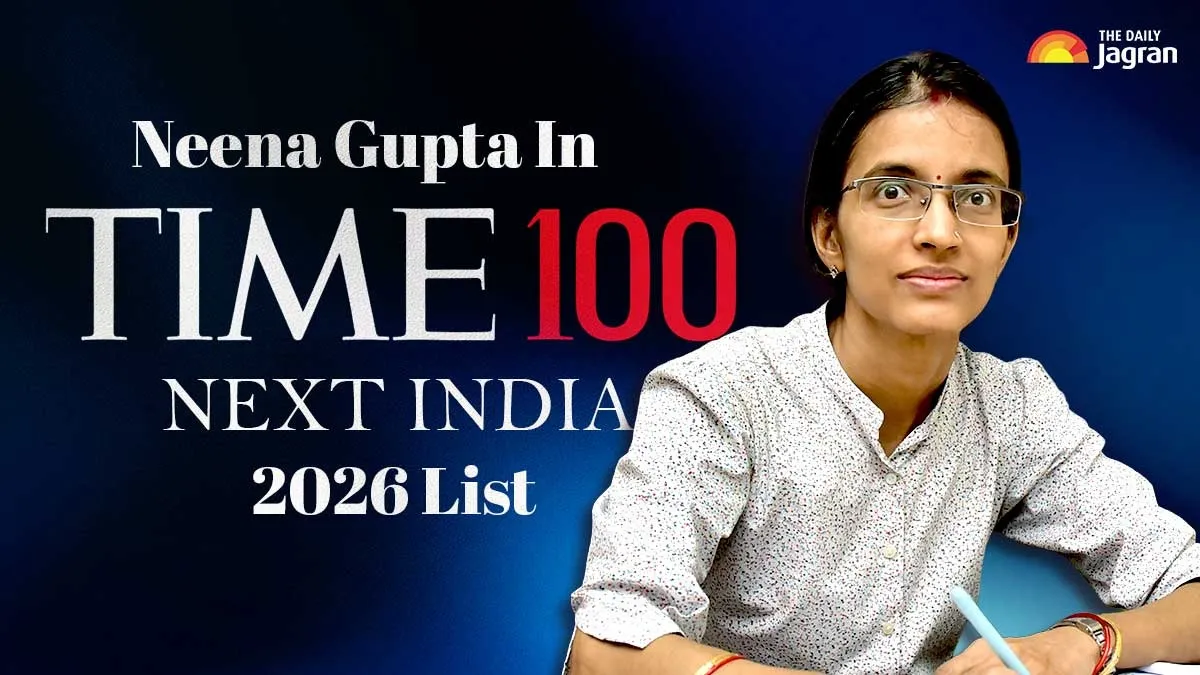
- Neena Gupta solved the 70-year-old Zariski Cancellation Problem.
- Recognized in TIME100 Next India 2026 for health and science.
- Her work in algebraic geometry earned multiple prestigious awards.
For nearly 70 years, some of the world’s brightest minds were stumped by the Zariski Cancellation Problem until Neena Gupta, a Kolkata-born mathematician, cracked it. Her relentless drive to challenge established ideas and explore the unknown has placed her on the TIME100 Next India 2026 list in the Health and Science Innovators category. She gained the spotlight in 2014 when she found a counterexample to a version of the Zariski Cancellation Problem. Her breakthrough brought her research in geometry into the international spotlight. Neena’s achievements resonate with her hard work and dedication that make everything possible.
Who Is Neena Gupta?
Neena Gupta was born on November 24, 1984, in Kolkata, West Bengal. With an interest in Mathematics at an early age, she grew up with parents who were good at the subject. The home environment thereafter helped her with her interest in the subject. She completed her Bachelor of Science (Honours) in Mathematics from Bethune College in 2006 and later joined the Indian Statistical Institute (ISI), Kolkata, to pursue a master's degree in Mathematics in 2008.
Talking with The Times of India, she recalled how her mother practised mathematics as a hobby rather than a part of her study schedule.
Her interest in the subject further earned her a PhD in Mathematics from ISI Kolkata in 2011, specializing in algebra under the guidance of Professor Amartya Kumar Dutta. Neena went back to ISI to continue her research and teaching career.
Recommended For You
What Is The 70-Year Zariski Cancellation Problem?
Neena’s moment came in 2014, following her work on the Zariski Cancellation Problem, a question in algebraic geometry. In 1949, Oscar Zariski, a mathematician, introduced the problem, asking a challenging question: if two mathematical objects become the same in structure after adding an extra dimension, does that mean the original objects were also the same?
In layman’s terms, picture two shapes that appear the same after an extra dimension is added. Does this mean that the original shapes were also the same?
For years, mathematicians tried solving it but failed. In 2014, Neena Gupta showed that the answer could be no when working in characteristic. Using a three affine variety, which was first created by mathematician Takanori Asanuma, she created a counterexample. It proved that mathematical spaces can become equivalent after an additional dimension is introduced, even when their original structures are not equivalent.
The landmark milestone proved how fundamental research can reshape the understanding of the longstanding mathematical problem. With this, Neena grabbed the spotlight and marked the beginning of a series of recognitions for her.
Neena’s Accolades And Achievements
A professor at the Indian Statistical Institute (ISI), Kolkata, Gupta has earned several accolades owing to her research in mathematics.
Saraswathi Cowsik Medal (2013): Awarded for her research on the Zariski Cancellation Problem by the TIFR Alumni Association
Indian National Science Academy Young Scientist Award (2014)
Shanti Swarup Bhatnagar Prize (2019): One of India's highest scientific honours
TWAS Young Affiliates (2020): Recognised among young researchers contributing to scientific research.
Ramanujan Prize (2021): She became the third woman to receive this international award. Awarded for her outstanding work in affine algebraic geometry and commutative algebra.
Nari Shakti Puraskar (2020 and 2021): Conferred by the President of India in March 2022 for her contribution to mathematics.
Infosys Prize (2024): Awarded in Mathematical Sciences for her work on the Zariski Cancellation Problem.
Neena’s feat holds a high regard for women's representation in STEM, showing how women can make a mark in highly specialized fields through years of dedication and hard work. Her work is not just to solve one problem but to help researchers and mathematicians understand how different branches of mathematics are linked.