
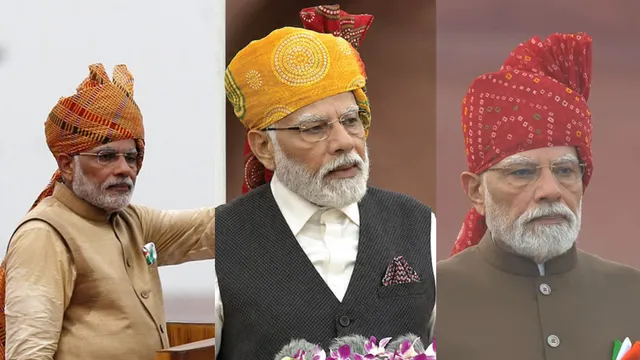
- PM Modi's turbans symbolize India's rich cultural diversity.
- Each year, unique styles and vibrant colors are featured
- His headgear choices have been a highlight since 2014.
Independence Day 2026: On the occasion of the 80th Independence Day, Prime Minister Narendra Modi was seen wearing a red tie-and-dye turban with a long trailing end as he appeared to address the nation at the Red Fort. The turban, hued in shades of red, green and white, reflected a combination of Rajasthani and Gujarati traditions.
ALSO READ: Independence Day 2026 Live Updates: 'Dimagi Naxals Must Be Identified And Isolated,' Says PM Modi
PM Modi’s Independence Day appearances have been closely watched over the decade, especially his turbans, which often reflected India’s diverse culture through colours and patterns. From a saffron turban with red motifs to bandhej lehriya, PM Modi’s choice of headgear has always stolen the spotlight during the August 15 celebrations. Here’s a look back to Prime Minister Modi’s carefully styled turbans, representing the richness of India’s cultural diversity in a unique yet striking way.
Turban Took A Saffron Turn In 2025
Last year (2025), Prime Minister Narendra wore a vibrant Rajasthani leheriya turban with hints of saffron, yellow, and green, with a saffron bandgala jacket and a stole. The 2025 event marked his 12th address to the Red Fort on the occasion of Independence Day
Recommended For You
2024 Was Marked By Dark Yet Striking Hues
In 2024, PM Modi wore a Rajasthani lehriya with hues of orange, dark green and yellow along the turban, which had a long pleated tail. Lehriya is a traditional Rajasthani design which gets its name from the desert winds.
2023: PM Chose Rajasthani Bandhani, 2022 Saw Safrron Hues
In 2023 Independence Day celebrations, PM Modi wore a Rajasthani-style Bandhani turban in shades of yellow, green and red with a black V-neck jacket, while in 2022, he chose a saffron turban with red motifs and flowing tails.
ALSO READ: PM Modi Unveils ‘Sapta Sindhu’ Vision, Names 7 Key Areas To Build Viksit Bharat By 2047 | Full List
COVID Year Saw Cream And White Headgear
In 2021, he wore a cream and saffron turban, while in 2020, during the COVID-19 pandemic, he covered his face with a white scarf with a saffron border.
2020: Safa As A Mask
In 2020, during the Covid 19 pandemic, PM Modi wore a saffron and cream turban with an extended tail. He paired it up a with a white kurta and churidar with a white stole.
2019 Witnessed Rajasthani Textile Heritage
PM Modi's first Independence Day appearance after his emphatic 2019 election victory came in a bright yellow safa with hints of green and red and a long tail.
2018 Was A Saffron Year
Saffron was the dominant colour in 2018.
PM Modi wore a saffron turban carrying red patterns, continuing two colours that would return repeatedly in his Independence Day appearances.
2017: Red, Yellow and a new India
Red and yellow came together in 2017, with golden criss-cross lines running through PM Modi's turban.
His message from the Red Fort was about what India could look like five years later.
2016 Saw A Mix Of Pink And Yellow
PM Modi's pink-and-yellow tie-dye turban was among the brighter headgears of his early years as Prime Minister.
2015: Yellow Turban with a long tail
If 2014 established the turban tradition, 2015 made it difficult to ignore.
PM Modi chose a predominantly yellow turban criss-crossed with multicoloured lines. Its most striking feature was its exceptionally long tail.
The speech produced a slogan that would soon become a government programme: "Start-Up India, Stand-Up India."
2014: When It All Began
The tradition started on PM Modi's first Independence Day as Prime Minister.
He arrived at the Red Fort in a bright red Jodhpuri bandhej turban, its long green tail providing a sharp contrast to his white half-sleeved kurta