
The Women's Reservation Bill, which proposes to give 33 per cent quota for women in Lok Sabha and state assemblies was introduced on September 19 in the lower house, a day after it was passed by the Union Cabinet. The tabling of the Bill, which has happened several times in the past 27 years but without success, has once again rekindled the hopes of women lawmakers as well as citizens for better representation in the legislative bodies. Former Congress president Sonia Gandhi, who began the debate this time, hailed the Bill saying it was the dream of former prime minister and her late husband Rajiv Gandhi.
What further raises the hopes of the nation is the way the debates in Parliament have evolved over time and the growing acceptance for the Bill among parliamentarians. From the first time the Women's Reservation Bill was introduced in 1996, to the discussion being held today, the debates in Parliament have gone through a lot of changes, including how the political leaders respond to arguments on the issue.
In another positive sign this time, regional parties, including Samajwadi Party and Bahujan Samaj Party, who had previously opposed the Bill, have also changed their approach to the Bill. While continuing their demand for separate 'quota within the quota' for women of SC, ST categories, the parties have backed the Women's Reservation Bill, 2023.
In the past, several women politicians were met with unfair treatment and had to face sexist remarks by their male colleagues during parliamentary debates.
Highlighting her own past experience during the first day of the debate in Lok Sabha, Nationalist Congress Party MP Supriya Sule on Wednesday, September 20, alleged that a Bharatiya Janata Party (BJP) leader had once told her to go and cook food. "Supriya Sule, ghar jaao, khana banao. Desh koi aur chala lega. (go home, cook food, someone else will run the country.) We will run the country," Sule quoted the remark of a saffron party leader.
She's not the only woman political leader to have faced sexist remarks during parliamentary proceedings. It goes back a long time in the past when making such remarks was not a big deal for the politicians. Let's take a sneak peek into the history when sexism and misogyny were clearly visible in politicians' words to their women colleagues:
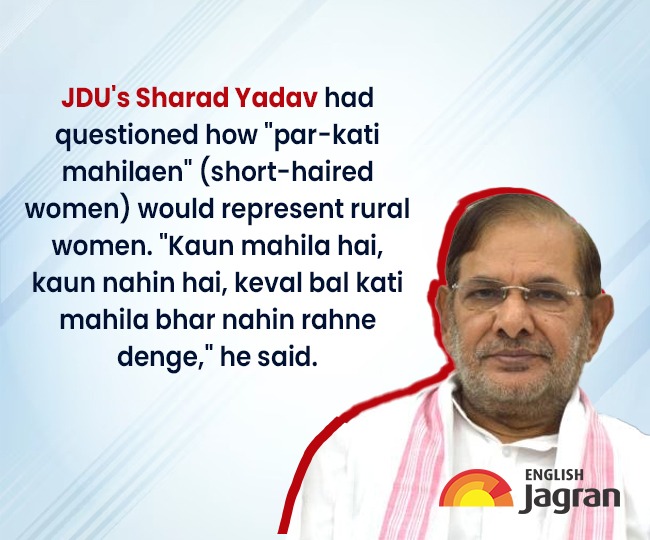
In 1997, senior JD(U) leader Sharad Yadav hurled a misogynist remark in Parliament during a debate on the Women's Reservation Bill as he asked how the country could entrust 'par-kati mahilaen' (short-haired urban women) with the responsibility to represent the causes of rural women. "Kaun mahila hai, kaun nahin hai, keval bal kati mahila bhar nahin rahne denge," Yadav had said, sparking a major controversy.
In 2012, a similar statement was reiterated by former Samajwadi Party (SP) supremo Mulayam Singh Yadav while he was addressing a rally. "The women reservation bill in its present form would only benefit rich and urban women... our poor and rural women are not attractive," he had said.
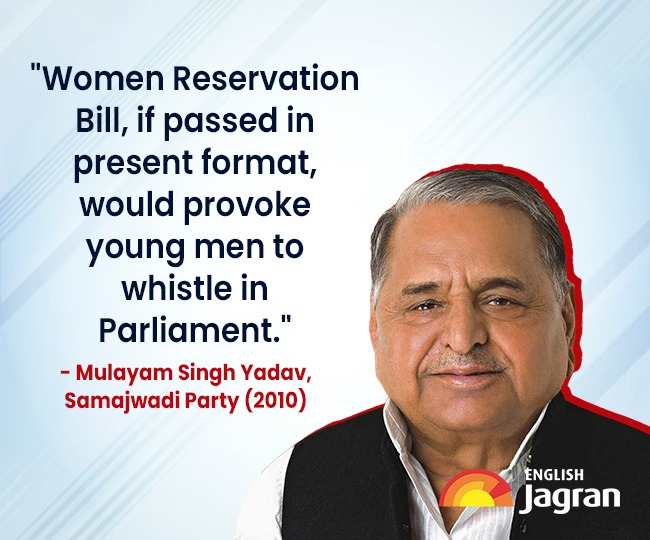
Earlier, in 2010, the Samajwadi Party leader had opposed the Bill on women's quota and said, "The Women’s Reservation Bill, if passed in the present format, would provoke young men to whistle in Parliament."
Besides the hurling of sexist comments in Parliament, both houses have also witnessed massive uproar and undignified behaviour by legislators over the Bill in the past. There are several instances when political leaders traded punches and abuses in Parliament.
On May 6, 2008, UPA listed the 108th Constitution Amendment Bill. The administration had to devise a floor plan to propose the bill and defend law minister Hans Raj Bharadwaj from physical assault by lawmakers from the "social justice" group, who vehemently protested against the bill. Ambika Soni and Kumari Selja sat on either side of Bhardwaj, who was surrounded by women parliamentarians as the members tried to snatch copies of the bill from his hands.
In another incident, West Bengal Chief Minister Mamata Banerjee had held SP member Daroga Prasad Saroj by the collar in order to stop him from approaching the Speaker's table in December 1998.