
- By Ajeet Kumar
- Sun, 13 Sep 2026 09:14 AM (IST)
- Source:JND
- BRICS declaration adopted in New Delhi, showcasing delicate balancing act.
- Ukraine war omitted, reflecting diverse member positions on conflict.
- Gaza crisis mentioned, US tariffs criticized, Iran-UAE tensions navigated.
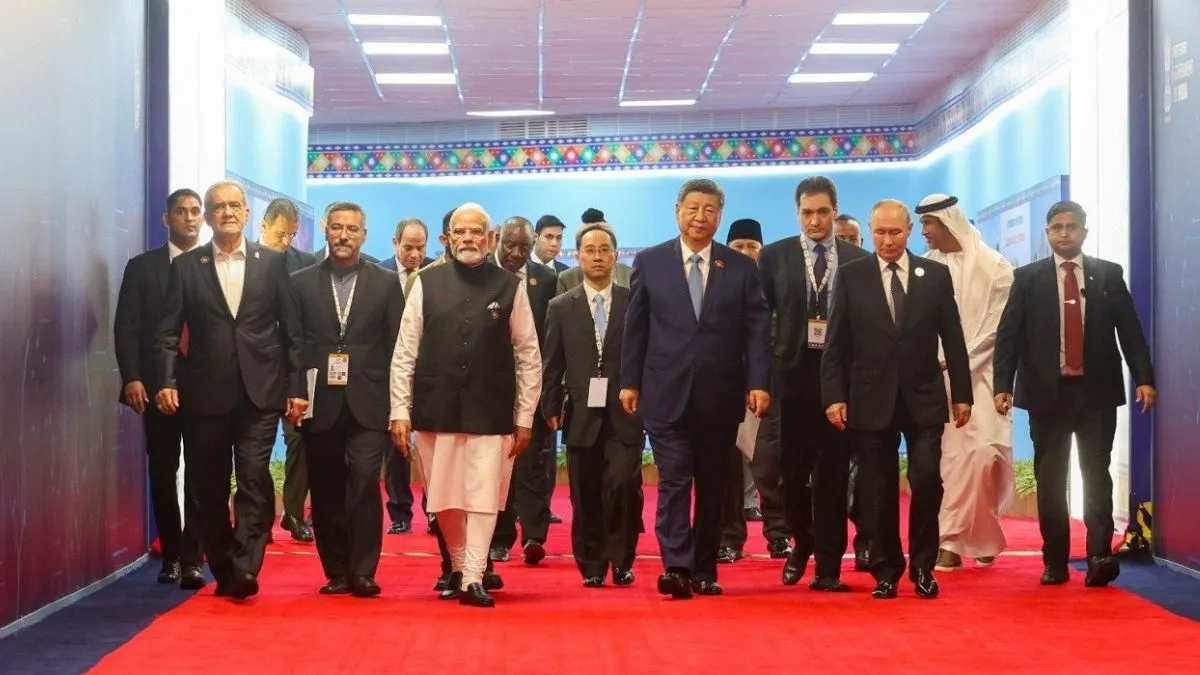
New Delhi: The 45-page BRICS declaration adopted at the summit in New Delhi reflects the delicate balancing act within the expanding grouping. Prime Minister Narendra Modi announced the adoption of the declaration at the end of the opening day's deliberations in the presence of Chinese President Xi Jinping, Russian President Vladimir Putin, Iranian President Masoud Pezeshkian, Abu Dhabi Crown Prince Mohamed bin Zayed Al Nahyan and other top leaders of the bloc.
In a major diplomatic victory for India, BRICS reached consensus on the joint declaration after overcoming sharp differences between the United Arab Emirates and Tehran regarding the West Asia conflict, but skipped any direct mention of the US strikes on Iran or the Iranian military's attacks on Gulf Arab nations.
No Mention of Ukraine War
One of the most notable features of the document is what it does not mention: the Russia-Ukraine conflict. Despite Russia being a key BRICS member, the declaration avoids directly referring to the war, signalling the bloc’s effort to accommodate countries with differing positions on the conflict.
ALSO READ: Xi Jinping Missing From BRICS Gala Dinner: Why Did China's President Skip It?
The omission also underlines the challenge of building consensus among an increasingly diverse group whose members have varying strategic and geopolitical interests.
Iran-UAE balance in West Asia
The declaration also carefully navigates the complicated relationship between Iran and the United Arab Emirates, both of which are now part of the expanded BRICS grouping. While the two countries have competing regional interests, the bloc has sought to keep its focus on dialogue and cooperation.
Against the backdrop of continuing tensions in West Asia, BRICS called for restraint and stressed the importance of protecting civilians and civilian infrastructure. The language reflects an attempt to address the region’s conflicts without allowing big geopolitical differences among members to derail the broader agenda.
A swipe at US tariffs
Trade was another major theme in the declaration, with BRICS taking aim at unilateral trade measures and protectionist policies. Without directly turning the document into an attack on Washington, the grouping criticised measures that disrupt global trade and called for a stronger multilateral trading system.
ALSO READ: BRICS Summit 2026: PM Modi, Putin, Xi Jinping, Masoud Pezeshkian Share Warm Moments | See Pics
The position comes amid heightened tensions over US tariffs and growing concerns about their impact on supply chains, international commerce and developing economies. BRICS’ emphasis on reforming the global trading system is part of its wider push for a more balanced international economic order.
Gaza gets a mention
The Gaza crisis also found a place in the declaration, although the reference was relatively measured. BRICS highlighted the humanitarian situation and the need to ensure access to aid, while avoiding language that could deepen divisions within the grouping.
Overall, the declaration illustrates the evolving character of BRICS: an increasingly influential grouping trying to speak collectively on major global issues while managing sharp differences among its own members. Rather than taking uncompromising positions on every conflict, the bloc appears to be prioritising consensus, economic cooperation and the broader principle of multilateralism.
(With inputs from agencies)