
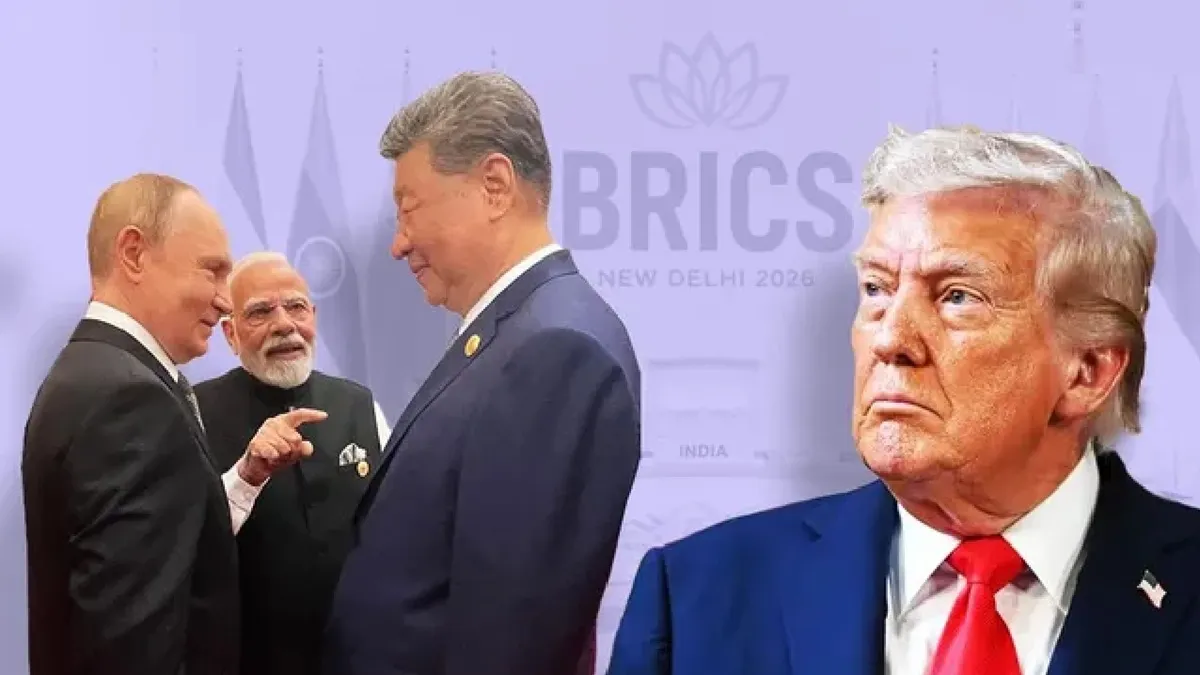
- BRICS summit 2026 in New Delhi addresses global instability.
- Each member pursues unique national interests and diplomatic goals.
- India focuses on development, multipolar world, practical cooperation.
Jagran Correspondent, New Delhi | With the global order reeling amid wars, sanctions, trade barriers and the West Asia crisis, the world is focused on the BRICS summit 2026 to be held in New Delhi on September 12-13. The 18th BRICS summit, scheduled to take place at Bharat Mandapam, will bring together 11 member countries. These countries represent nearly half the world's population and a significant share of the global economy, giving BRICS increased diplomatic clout.
However, BRICS has yet to establish a single, comprehensive agenda. Each country is using this platform to advance its own national interests. This time, the story is no different.
China wants to showcase its partnership in the face of declining US trust, India wants to focus on development and practical cooperation, Russia wants to assert its global presence despite sanctions, while Iran wants to share a platform with major powers and send a diplomatic message.
Brazil, South Africa, Egypt, Ethiopia, Indonesia, Saudi Arabia and the UAE are also bringing issues such as energy, trade, Africa-Asia connectivity and transactions in local currencies.
Trump's Areas Of Interest
US President Donald Trump has not made any remarks on the BRICS summit 2026, but he would have an eye on the India-hosted event. With the presence of Masoud Pezeshkian, Xi Jinping and Vladimir Putin at the global event, the US would keenly observe meetings and declarations, as the US has been at war with Iran, supporting Ukraine and imposing tariffs against China. Trump would not want Iran to get more support from the Asian powers. China's rise on the global stage also makes him uncomfortable.
Recommended For You
China: The Road To Global Power
China’s long-standing intention has been to present BRICS as an alternative to the US-centric world order. President Xi Jinping’s agenda is clear: while the trust of many countries in the United States is wavering, major nations like Russia and India, along with countries such as Ethiopia and Indonesia, are sharing ideas under China’s leadership within the same organisation.
ALSO READ: BRICS Summit 2026: China Confirms Xi Jinping's India Visit After Intense Speculation
He also wants to expand BRICS to make it more influential. China will advocate for increased trade in local currencies and global governance reforms, particularly in the IMF and the United Nations, to increase the voice of developing countries.
India: Multipolar World Is The Big Agenda
Host India's agenda reflects the pragmatism of its traditional diplomacy. India is a member of the Quad with the US, and of the SCO and BRICS. India sees a multipolar world as in its interest and strives to achieve it everywhere. Furthermore, India wants to make BRICS a platform for development cooperation, not an anti-Western alliance.
India will emphasise MSMEs, startups, digital public infrastructure, payment mechanisms like UPI, artificial intelligence, and clean energy. India is also trying to build consensus among countries like Iran and the UAE to ensure the joint statement doesn't get bogged down. As host, New Delhi aims to move beyond BRICS discussions to concrete outcomes.
Russia: Global Presence Despite Sanctions
President Vladimir Putin will use the forum to demonstrate that Western sanctions have not isolated Russia. Moscow claims that most of its payments with BRICS countries are now made in national currencies. Russia will discuss food security, grain trade, energy cooperation, defence, and transport corridors.
He wants to make BRICS a platform for alternative financial arrangements, where it can exit the Western countries' SWIFT payment system, although countries like India do not want to make it a direct anti-dollar campaign. Trade, energy, and defence projects are likely to be raised in the Putin-Modi bilateral meeting. For Russia, the meeting is also a demonstration of diplomatic legitimacy that major economies like China and India are sitting at the same table with it.
Iran: Its Back Is Not Broken, Many Countries Are With it
Iran's primary agenda is to demonstrate to the world that it is neither broken after five months of war nor lacking allies on the global stage. It sees the summit as a diplomatic relief amid US pressure and regional tensions.
President Masoud Pezeshkian will also want to convey to his internal opponents that Tehran is not completely isolated. Iran wants to increase trade, energy exports, the Chabahar port, and payments in local currencies. It will assert its position on the West Asia crisis and corner the UAE.
Brazil: The Global South And The Environment
In President Lula's absence, Brazil will send a high-level delegation. Brazil is likely to emphasise climate finance, Amazon protection, agricultural exports, and concessional finance for developing countries. It wants to maintain BRICS as a platform for cooperation and seeks increased resources for green projects from the New Development Bank.
South Africa: The Voice of Africa And Mineral Supply
President Cyril Ramaphosa will advance the African agenda, seeking to link South Africa's industrial development, critical minerals, energy transition, and African Union priorities with BRICS. He may reiterate his call for increased African representation in global institutions.
Egypt: Suez, Energy And Regional Stability
President Abdel Fattah al-Sisi will focus on trade routes, energy cooperation, and food security. Egypt wants to connect the Suez Canal and regional connectivity to the BRICS supply chain. West Asia peace and investment will also be on his agenda.
Ethiopia: African Development And Infrastructure
Prime Minister Abiy Ahmed wants development finance, infrastructure, agriculture, and investment for Africa. Ethiopia wants BRICS to be a partner in African industrialisation and energy projects.
Indonesia: Indo-Pacific Region And Trade
As a new full member, President Prabowo Subianto will emphasise trade, maritime connectivity, food security, and the digital economy. Jakarta wants BRICS to be a bridge between ASEAN and the Global South.
He will also seek to project his country more strongly in the Indo-Pacific region. Indonesia also sees itself as a future global power and wants to expand its role through smaller organisations like BRICS.
UAE: Energy And The West Asia Crisis
The UAE's primary agenda this time around is to ensure that Iran does not engage in unilateral discussions on the West Asia crisis at the BRICS summit. This has been indicated in meetings between foreign ministers and the National Security Advisors (NSA). The UAE will also seek to reassure BRICS nations that global energy trade is not contributing to rising crude oil prices.
(With Input from Jayaprakash Ranjan)
You May Also Like To Watch