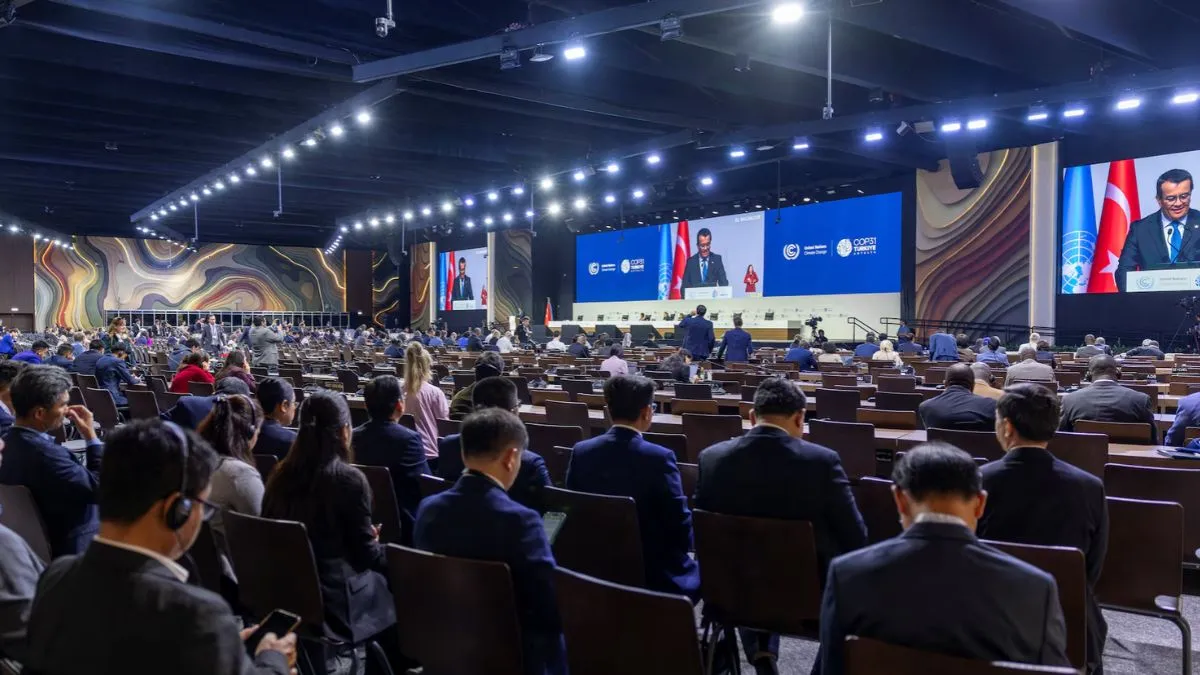
- COP31 climate talks in Antalya concluded without a final agreement.
- Disagreements on phasing out fossil fuels and climate finance caused deadlock.
- India stressed equity, CBDR-RC, and continued domestic climate action.
COP31 Talks Collapse: The 31st Conference of the Parties to the United Nations Framework Convention on Climate Change (UNFCCC), held in Antalya, Turkiye, ended without an agreement despite a marathon debate. The failure has exposed deep divisions among countries over how the world should tackle climate change. The negotiations continued for more than 44 hours beyond the scheduled closing time and still failed to reach a final agreement after.
Big Climate Summit Ends Without Agreement
At the centre of the talks was a question, should the world commit to moving away from coal, oil and gas, or should countries retain the freedom to use these fuels while exploring other ways to cut emissions? However, disagreements over climate finance also added to the deadlock, leaving countries worried about how they will deal with the growing effects of global warming.
Why Did COP31 End Without Agreement?
According to reports, the disagreement over fossil fuels was the biggest obstacle to reaching an agreement. Several countries wanted the final document to include a clear commitment to gradually move away from coal, oil, and gas. However, oil-producing countries resisted including such a commitment. Countries including Panama, Vanuatu and the Marshall Islands rejected the text, stating that an agreement without any reference to fossil fuels would weaken the message of previous climate commitments.
Recommended For You
Antalya COP 31 has failed future generations. I say this as Prime Minister of The Bahamas, and I lend my voice to our partners in the Caribbean Community and to the small island and developing nations that were asked to accept that failure in silence. We reject it, and we will say so in every forum open to us. After almost two days of overtime, the longest climate conference on record ended in Antalya without a final agreement. For the first time since Copenhagen in 2009, the nations of the world could not agree on what to say about the greatest danger they share. Narrow self-interest caused this failure. A small number of oil and gas producers put their revenues ahead of the safety of billions of people. They used the rule of consensus, a rule meant to give every nation an equal voice, as a weapon to strip the cause of the crisis from the text. Three years ago in Dubai, the nations of the world agreed by consensus to transition away from fossil fuels in their energy systems. In Antalya, they could not bring themselves to write those words again. The final text did not mention fossil fuels at all. The draft would have recorded, for the first time in a United Nations decision, that the world is on course to break the 1.5°C limit. On the same page, they refused to name the cause or acknowledge it. It dropped the proposed target of US$120 billion a year to help vulnerable nations adapt. That is the text small states were asked to sign. The Caribbean Community, negotiating as its own bloc at a COP for the first time, refused to accept that text. So did the Alliance of Small Island States. They were right. Had they signed, they would have accepted their own harm in writing. The Bahamas, a member of both, stood with them. The heaviest cost of Antalya falls on people who were not there. The generations who will inherit this planet had no seat at the table. They depend on those of us in the room to speak for them. They will live with every word that was struck from that text. The treaty that brought the world to Antalya makes a promise to them. Its first principle asks every party to protect the climate system “for the benefit of present and future generations of humankind”. Last year, the International Court of Justice unanimously confirmed that states carry binding obligations under international law to protect the climate system. In Antalya, those obligations were traded for the profits of the present. This failure will outlive everyone in this room. It will outlive our generation. The sea will go on rising for centuries, even after emissions stop, because the deep ocean and the great ice sheets respond slowly to the heat we add today. Every year of delay fixes a burden on people who will live centuries from now, and they will have no way to send it back. Those who blocked progress have misjudged even their own interest. The sea is rising on their coasts too. The heat is reaching their cities too. Their own children and grandchildren will inherit the world their delay is building. In 1992, the Guyanese statesman Sir Shridath Ramphal wrote a book for the Earth Summit and called it Our Country, The Planet. Wherever we live, we share one atmosphere and one rising sea. Small nations have always understood that. In Antalya, too many nations negotiated as if the atmosphere had borders and the sea respected flags. Small island states produce less than one per cent of global emissions, yet we carry the weight of a crisis we did not cause. We have brought plans, commitments and patience to three decades of these talks. Antalya exhausted that patience. We will return to the table, because it remains the one place where a small nation can stand as an equal. We will keep our names off any text that asks our people to accept their own harm. With our partners in CARICOM and the Alliance of Small Island States, we will press for real results by the end of 2027, when the world meets in Addis Ababa for COP32. Generations not yet born will ask whether we acted when we knew. Antalya gave them a shameful answer. Addis Ababa must give a better one. #COP31
— Philip Brave Davis (@HonPhilipEDavis) November 23, 2026
Ireland's climate minister, Darragh O'Brien also criticised the proposed document, saying, "We will not endorse a cover decision... that does not even mention fossil fuels, which is the key driver of climate change."
Saudi Arabia, Iran And Russia Opposed Deal
Saudi Arabia, Iran and Russia were among the countries that resisted language calling for a transition away from fossil fuels as oil and gas are central to their economies. They argued that talks should focus on reducing pollution and not excluding energy sources. For major oil and gas producers, a commitment to phase down fossil fuels could affect future demand, investments and economic planning. Russia's representative made its position clear, saying, "We cannot agree to any wording on fossil fuels." As a result, the talks ended without any agreement.
What India Said And What It Opposed
India, on the other hand, approached the negotiations from the perspective of climate justice and fairness. It argued that developing countries should not be expected to follow the same energy transition pathway as wealthy nations. Environment Minister Bhupender Yadav said India had participated constructively until the final stages and regretted that consensus could not be achieved. He also stressed that the absence of a final agreement would not stop India's domestic climate action.
"At #COP31 in Antalya, Türkiye, India engaged constructively till the very end, working with BASIC and LMDC partners for a balanced outcome rooted in equity, CBDR-RC, climate finance and adaptation. We regret that consensus on the cover decision could not be reached. India's voice shaped the draft COP31 outcome: food security, livelihoods and cultural practices recognised in action on methane; Article 9.1 obligations of developed countries recalled; equity and CBDR-RC at the heart of implementation," Yadav wrote on X.
India strongly emphasised the principle of Common But Differentiated Responsibilities and Respective Capabilities (CBDR-RC). Under this principle, all countries must address climate change, but developed nations should carry greater responsibility due to their historical emissions and greater financial capacity.
At #COP31 in Antalya, Türkiye, India engaged constructively till the very end, working with BASIC and LMDC partners for a balanced outcome rooted in equity, CBDR-RC, climate finance and adaptation. We regret that consensus on the cover decision could not be reached. India's voice shaped the draft COP31 outcome: food security, livelihoods and cultural practices recognised in action on methane; Article 9.1 obligations of developed countries recalled; equity and CBDR-RC at the heart of implementation. Climate ambition must go hand in hand with means of implementation. Energy transitions must be nationally determined, just and equitable, backed by finance, technology and capacity-building for developing countries. The absence of a cover decision does not pause climate action. India continues to deliver at home, with over 170 GW of solar capacity, and remains committed to consensus-based multilateralism on the road to COP32. India, for like minded developing countries, raised a fundamental question at COP-31: Why are we here, and how did we arrive at this climate crisis? Historical and continuing emissions have consumed a disproportionate share of the global carbon budget. Equity and climate justice must therefore remain at the heart of our collective response. India engaged constructively and tirelessly with the Presidencies and other Parties. While concerns remain over certain elements of the cover decision, we remain committed to dialogue and constructive engagement until the very end to build consensus.
— Bhupender Yadav (@byadavbjp) November 22, 2026
India also opposed unilateral trade measures, including carbon border taxes, arguing that such policies could disadvantage developing economies. New Delhi supported a plan that allows developing countries to keep using these traditional fuels to grow their economies and help their people, while also building more clean energy like solar and wind power.
What Happens Next?
The collapse of COP31 has raised questions about whether the current consensus-based negotiating system can deliver strong and meaningful climate action. The unresolved issues will now remain central to preparations for COP32 in 2027. Countries will have to revisit the disagreements over topics such as fossil fuels and climate finance
The stakes are high as the world is moving closer to, and is expected to exceed, the 1.5-degree Celsius warming threshold. Also, the failure at Antalya does not end national climate efforts, therefore, countries can work on their climate action plan.
ALSO READ: El Nino Pushing World Into 'New Age Of Climate Extremes'; Impact On India Explained
You May Also Like To Watch: