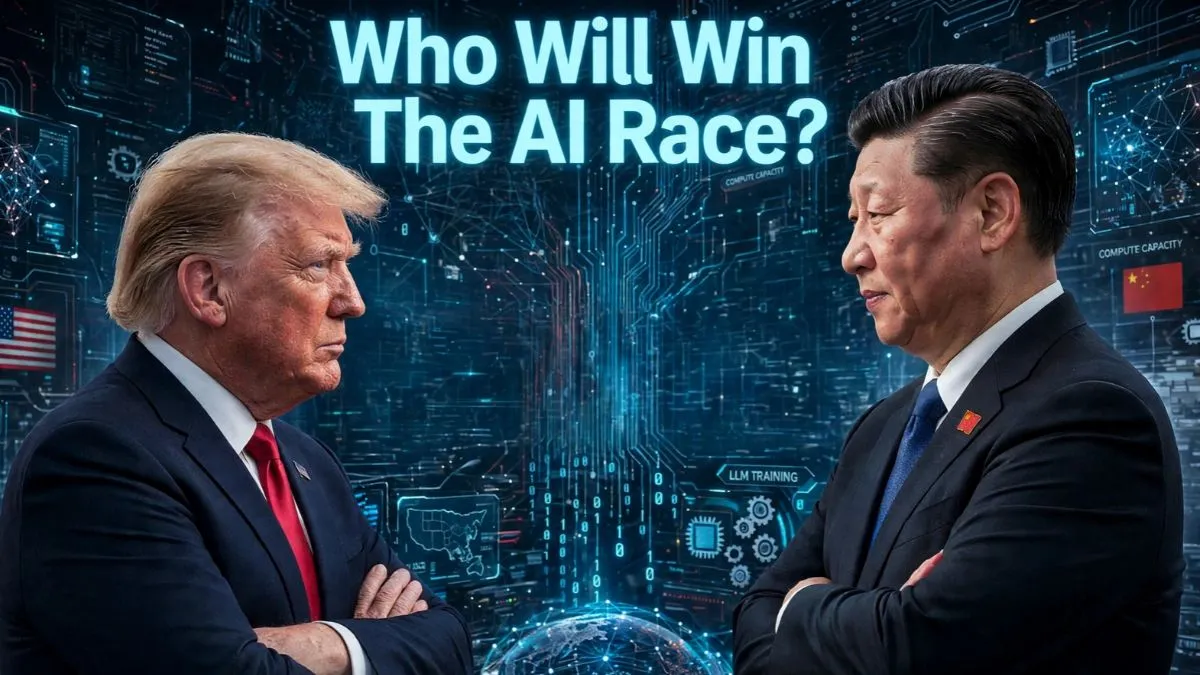
- Trump asserts US leadership in Superintelligence at APEC summit.
- US opposes global AI regulation; China seeks open cooperation.
- Both countries also differ on AI development and governance approaches.
Global AI Race: United States President Donald Trump has once again asserted US' leadership in artificial intelligence by calling the country the world leader in 'Superintelligence' (SI) at the Asia-Pacific Economic Cooperation (APEC) summit on Thursday. In a meeting, chaired by Chinese President Xi Jinping, Trump warned against global regulations or any measures that could control or slow down the development of the technology. His remarks come as Beijing is also stepping up its efforts to expand its influence in the global AI race.
Trump Touts US As 'World Leader' In SI
While both countries see AI as a major driver of future economic growth and global power, they differ sharply on how the technology should be developed, shared, and regulated. The latest episode at the APEC summit has also highlighted this. "The US is also proud to be the world leader in superintelligence (SI)...It's superintelligence, that's what it is, but we have to watch it. We have to be careful. We have to cherish it. It's almost completely good, but it's got some bad elements, so we have to be very careful in managing those bad elements. We oppose any form of globalist regulation or anything to control or stifle SI, and we won't allow that to happen," Trump said while addressing the leaders.
#WATCH | Shenzhen, China: At the 33rd APEC Economic Leaders' Summit, US President Donald Trump says, "We're negotiating numerous trade agreements with some people sitting at this beautiful table. We have a lot of trade agreements that will be signed in the not-too-distant future with very major countries. The United States is also proud to be the world leader in superintelligence (SI), the greatest technological transformation since the Industrial Revolution. Americans invented SI and it is unleashing extraordinary prosperity and growth for people all around the globe. So we do not want to do anything to destroy the tremendous potential of this technology. It's superintelligence, that's what it is, but we have to watch it. We have to be careful. We have to cherish it. It's almost completely good, but it's got some bad elements, so we have to be very careful in managing those bad elements. We oppose any form of globalist regulation or anything to control or stifle SI, and we won't allow that to happen..." (Source: US Network Pool via Reuters)
— ANI (@ANI) November 19, 2026
ALSO READ: Trump Discusses Former Nvidia CEO's Issue With Xi, Calls Alice Huang 'Pretty Woman' Amid Spy Claims
China Pushes For Open AI Cooperation And Global Rules
Trump's remarks also reflect the administration's push to maintain Washington's lead in advanced AI development while avoiding international restrictions. Meanwhile, China is seeking a greater role in shaping how AI is developed and governed across the world. In July, Xi had presented China as a key force in global AI cooperation during his address at the World Artificial Intelligence Conference (WAIC) in Shanghai.
Recommended For You
Xi urged countries to make use of the opportunities offered by open-source AI and called for greater cooperation. He also offered support to developing nations to strengthen their AI capabilities, warning that unequal access to technology could create "new historical injustices". "AI development should not be a solo performance by a single country," Xi said without naming the US. He described it instead as a "symphony of international cooperation."
At the recently held BRICS summit in New Delhi, Xi had also proposed a BRICS AI open-source community and a shared digital ecosystem cloud platform. Through this, he aimed to give developing nations an alternative to costly or proprietary Western AI systems.
Why US And China Differ On AI
While Washington and Beijing agree that AI will play a major role in shaping the global economy and tech power, their approaches to its development have largely remained different. The US follows a largely market-driven model, with private technology companies leading the development of advanced AI systems. Many American companies are reportedly investing heavily in computing infrastructure and frontier models. They focus on achieving Artificial General Intelligence (AGI).
However, China is focusing on wider AI adoption, industrial use and open-source or open-weight models. Its approach aims to make AI more affordable and accessible, particularly in developing countries. Beijing is also trying to integrate AI into manufacturing, robotics, and other industrial sectors
Not only this, the two countries also differ on regulation. The US generally relies on private-sector innovation, voluntary commitments, scrutiny after products are released and national security measures, with states and government agencies playing a role in implementation. China follows a more centralised, state-directed approach, with national plans, strict content and algorithm rules, and censorship requirements.
The US has also used export controls to restrict China's access to advanced AI chips and computing hardware. However, China has tried to gain an edge by using critical minerals and rare-earth processing as a strategic tool.
Where Does India Stand In AI Race?
India has emerged as one of the world's largest users of AI technology. However, its position in the global AI race remains different from that of the US and China. This is because India's access to advanced technology and powerful models remains a challenge. While India has come up as an important market for AI adoption, it is also working to strengthen its own AI capabilities.
In this regard, the government launched the IndiaAI Mission in March 2024 with an outlay of Rs 10,372 crore. It focuses on developing computing capacity, innovation, application development, datasets/models (via AIKosh), startup financing, FutureSkills, and safe/trusted AI use. Moreover, India also advocates for global collaboration on AI to ensure the technology is developed and deployed safely and responsibly.
However, rather than adopting strict, uniform international rules, New Delhi favours a flexible governance model that encourages technological innovation and adapts to local needs.
ALSO READ: Trump Discusses Former Nvidia CEO's Issue With Xi, Calls Alice Huang 'Pretty Woman' Amid Spy Claims
You May Also Like To Watch: