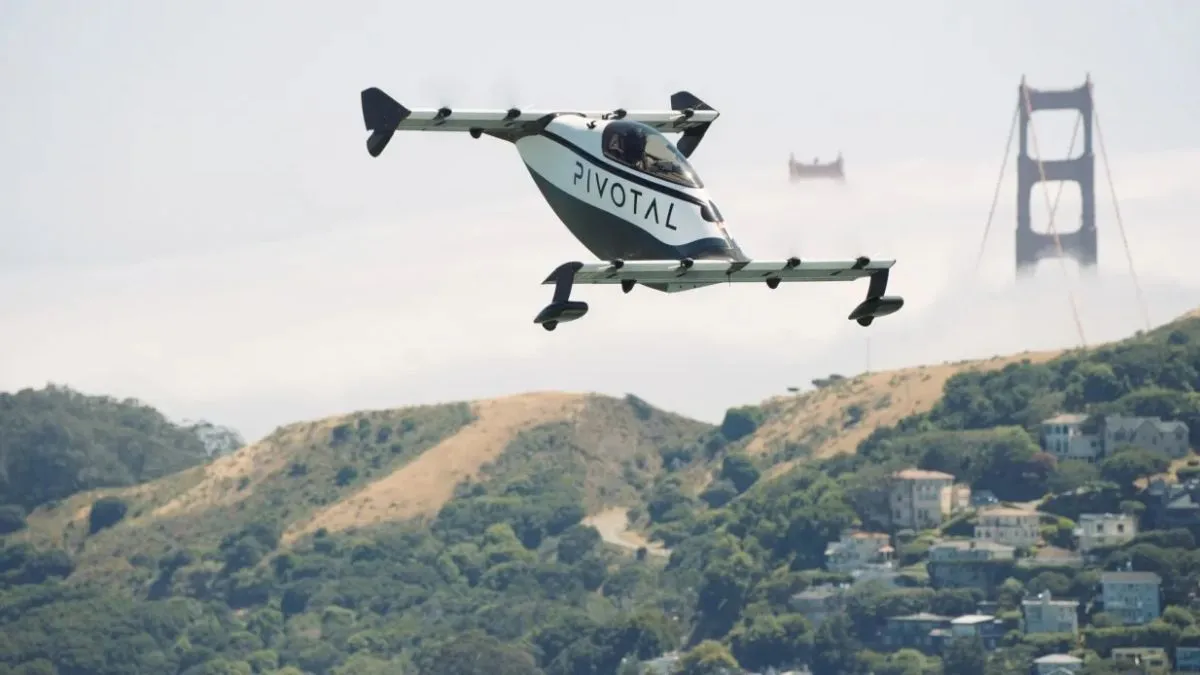
- Pivotal Helix: single-seat, all-electric VTOL aircraft for personal use.
- Fly without pilot's license under FAA Part 103 ultralight category.
- Priced at $190,000, deliveries targeted for 2027 after final testing.
Imagine flying your own aircraft without holding a pilot's licence. A Silicon Valley aerospace company is working to make that possibility a reality with Helix, a single-seat, all-electric aircraft designed for personal flying and short-distance travel. Developed by US-based company Pivotal, Helix is a vertical take-off and landing (VTOL) aircraft that can lift off and land without requiring a conventional runway. The company aims to make flying accessible to people with little or no previous aviation experience, with first deliveries planned for 2027.
According to CNN, Pivotal's vice president and chief of flight, Kristina Menton, said the company has trained people from different professional backgrounds, including schoolteachers, accountants and engineers, some of whom had never flown an aircraft before.
How Does The Helix Aircraft Work?
Unlike conventional aircraft and several other electric vertical take-off and landing vehicles, Helix rotates its entire airframe to transition between vertical take-off and forward flight.
The aircraft features 16 propellers powered by individual electric motors, distributed across two tandem wings. It initially rises nose-first before tilting forward, allowing its wings to generate aerodynamic lift for horizontal flight.
The aircraft is controlled through a single joystick connected electronically to 16 actuators. A 12-inch touchscreen display provides flight information, while a camera helps the operator identify the landing area.
Helix can reach a cruising speed of around 66 miles per hour and has a maximum range of approximately 20 miles. It produces around 70 decibels of noise when measured from the ground at an altitude of 150 feet, making it considerably quieter than conventional helicopters.
Its battery can be charged using household electricity. Pivotal estimates that charging takes approximately 75 minutes with a 240-volt connection and four-and-a-half hours with a 120-volt supply.
Why You Don't Need A Pilot's Licence
The Helix is classified under the US Federal Aviation Administration's (FAA) Part 103 ultralight category, which permits recreational operation without a conventional pilot certificate, subject to specific conditions.
However, flying without a licence does not mean flying without training. Pivotal requires prospective operators to complete a mandatory training programme that generally takes five days, although it can be completed in as few as three days.
The programme includes virtual reality simulator sessions, emergency procedures, practical flying exercises and eight training flights, followed by an evaluated flight.
The aircraft also incorporates several safety features, including a triple-redundant flight control system, an emergency ballistic parachute and floats.
$190,000 Price Tag Raises Questions About Practicality
The Helix is available for pre-order at a starting price of USD 1,90,000. However, its affordability and practical applications remain important questions.
Aviation expert Ryan Wallace of Embry-Riddle Aeronautical University's Centre for Advanced Air Mobility told CNN that the aircraft could appeal to a relatively small market because of its high price, limited passenger capacity and 20-mile range.
Pivotal believes the aircraft could eventually find applications beyond recreational flying, including military operations and emergency response services.
The company has also explored its potential for medical emergencies. In August, a Pivotal electric aircraft was reportedly used by paramedics in two live emergency calls involving advanced life support in partnership with Hyde County Emergency Medical Services.
With final testing underway and deliveries targeted for 2027, Helix could offer a glimpse into a future where personal flying becomes more accessible, although regulatory restrictions, cost and practical limitations remain significant challenges.