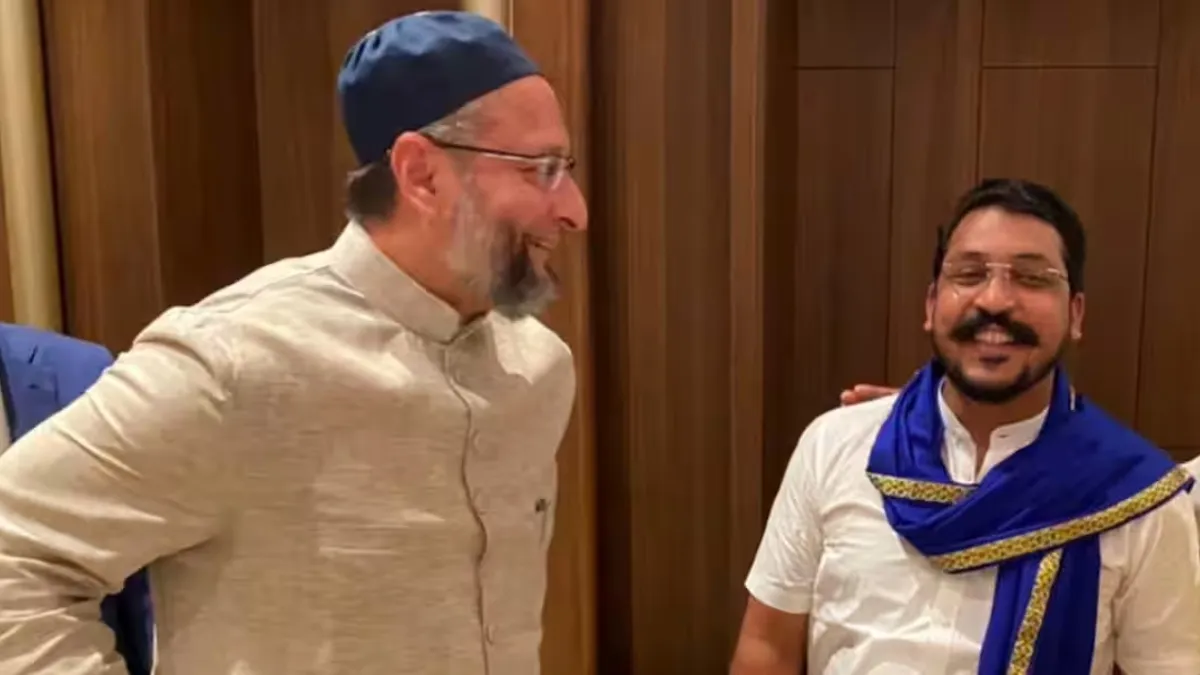
- AIMIM and ASP forming pre-poll alliance for UP elections.
- Alliance targets Dalit and Muslim vote banks in Uttar Pradesh.
- Could create a third front, impacting existing political parties.
In a major development ahead of Uttar Pradesh Assembly polls, Asaduddin Owaisi's AIMIM and Nagina MP Chandra Shekhar Azad's Azad Samaj Party (ASP) are set to forge a pre-poll alliance. While there is no official confirmation from the top brass of both the parties, reports suggest that the talks are in the final stage and four rounds of discussions have already taken place.
The two parties are reportedly discussing the distribution of Muslim-dominated seats, as AIMIM is stressing to contest from their seats while ASP wants to solidify its ground in those constituencies.
Where does Chandrashekhar's ASP stand?
The seat sharing is likely to be finalised in a few days and could at maximum stretch to November 26 when Chandra Shekhar is set to hold a mega rally at Lucknow's Ramabai Maidan. Chandra Shekhar has adopted former UP CM and senior Dalit leader Mayawati's approach by declaring constituency in-charges first and pitting them as candidates later.
Notably, Mayawati is the only leader in Indian history to have managed to pull a crowd so vast as to fill the entire ground, which has a capacity of over 5 lakh people. Chandra Shekar is looking to repeat history on Nov 26 to place himself as an undisputed Dalit leader in the state.
Recommended For You
AIMIM's approach
On the other hand, AIMIM chief Asaduddin Owaisi is aggressively campaigning across the state as part of his wider ambition to expand beyond his stronghold Hyderabad. The party has proved itself consequential in several elections including twice in Bihar's Seemanchal region and Maharashtra local body elections, among others. However, UP has been a hard nut to crack for him so far. In the last assembly elections in 2022, his AIMIM joined hands with Apna Dal (Kamerawadi), led by Pallavi Patel, but failed to open an account. This election, Owaisi's approach has been more direct with early local-level outreaches and public engagement. Guided by past experiences and political nuances, Owaisi is looking for a stronger alliance this time. While he fiercely criticised Congress and Samajwadi Party during his UP campaign addresses, he also seldom spoke about readiness to enter an alliance with the parties.
The coming together of two parties, particularly the two leaders, could alter the political dynamics in the state and impact not just one but all parties in the state. Chandra Shekar's ASP has grown its influence among Dalit voters, both Jatav and non-Jatav, while Owaisi has maintained his pitch to Muslim voters to leave traditional BJP opposition for AIMIM.
Caste equations, seats influence, and where do these parties stand
Dalits make up around 21 per cent of the state's population while Muslims comprise 19 per cent of the population. Collectively, their strength is 40 per cent, a vote bank that could swing elections entirely. BSP and AIMIM are trying to achieve the same. However, it is no easy task as BSP leader Mayawati failed to achieve it even during peak of her power in the 2007 assembly elections.
Out of a total 403 seats, Dalits have a population more than the state average across 148 seats. Kaushambi, Hardoi, Rae Bareli, Sitapur and Unnao districts each have SC populations above 30 per cent.
122 seats in the state have about 20-30 per cent Dalit voters while eight have a population of over 40 per cent. Similarly, there are 46 assembly seats where the Muslim population ranges from 30 to 60 per cent. These include Tahkurdwara in Moradabad, Lucknow West, Moradabad Rural, Chamraua in Rampur, etc.
Chandra Shekhar comes from the Jatav community, which has 12 per cent votes and has traditionally been a vote bank of the BSP but has now switched loyalty to ASP, Samajwadi Party, Congress and, to an extent, the BJP.
Chandra Shekar, in the past years, has made rounds across the state to build its party's base and has gained influence. These elections will be a litmus test of his popularity, as for the first time his party has gained popular attention.
To make an impact in the polls, ASP has not limited itself to Jatav or Dalit candidates. ASP has released two lists with a total of 87 candidates, with 29 OBCs, 19 Muslims, 1 Sikh and 38 Dalits.
According to reports, ASP and AIMIM are considering sealing an arrangement where the Owaisi party will contest 45 seats while the rest will remain with ASP. If formed, the alliance could emerge as a third front that too, without Brahmin or OBC domination.
Besides, the alliance would mostly hurt the INDIA bloc led by Samajwadi Party's Akhilesh Yadav, who has made (Pichda, Dalit, Alpasankyak) PDA as his policy. Akhilesh has so far managed caste equations well, maintaining a balanced and respectful stance on the upper caste without upsetting his core OBC and Muslim voters. The cropping of a new alliance could favour BJP-led NDA.