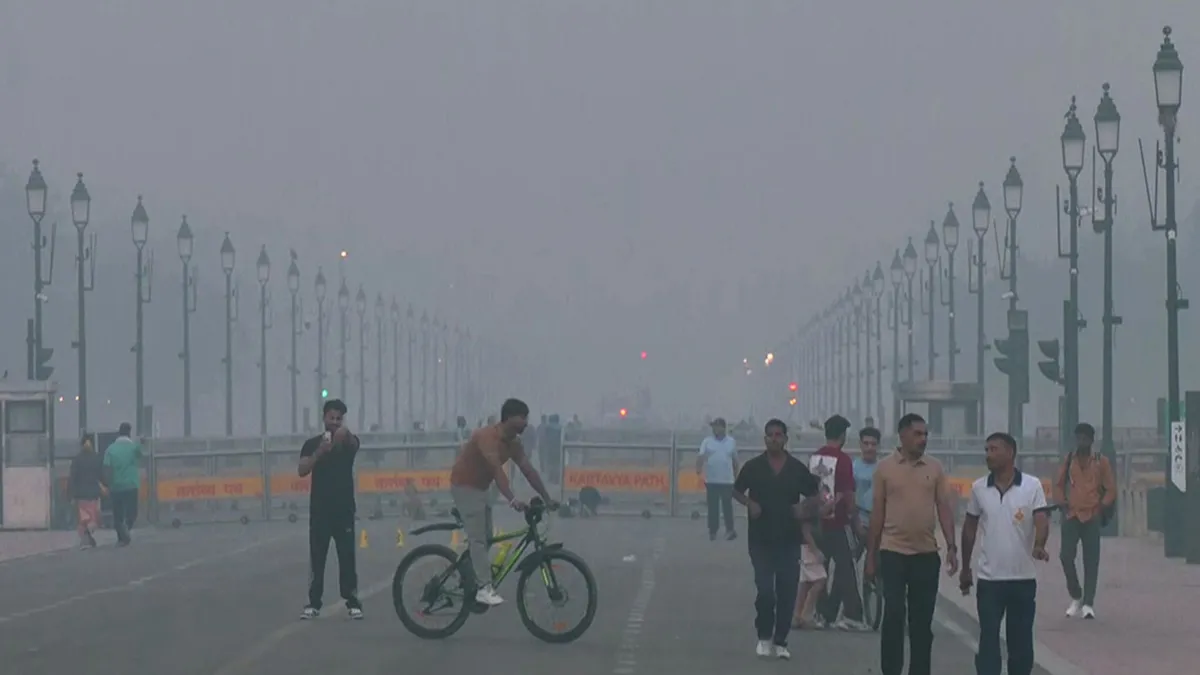
- Delhi's air quality predicted to worsen to 'very poor' category.
- Vehicular emissions identified as primary contributor to city's PM2.5.
- Experts advise extra care for children, elderly in coming days.
After worsening to the severe category during Diwali and thereafter, Delhi's air quality improved slightly but remained in the 'poor category' for the past seven days. However, this mild relief is also set to end soon as the air is likely to worsen in the coming days.
The city's air quality has improved marginally over the past three days, dropping from 280 on November 19 to 270 on November 20 and 265 on Saturday.
Air to turn very poor for next six days
The Air Quality Early Warning System (AQAEWS), the forecasting and alert system run by the Indian Institute of Tropical Meteorology (IITM) and the India Meteorological Department (IMD), has predicted that the capital's air quality will remain in the poor category on Sunday but may reach the very poor category in the next six days.
On Saturday, the Air Quality Index (AQI) was rated in the poor category at 265. Out of 56 air quality monitoring stations, 32 were in the poor category, 16 in the very poor category and seven in the moderate category, while one was in the satisfactory category.
Recommended For You
The air quality at Delhi Technological University (DTU) was the highest, with an AQI of 362. The AQI in the Delhi Cantonment area was 80.
The main cause of pollution was vehicular emissions. According to real-time source identification estimates from the AQEwS, vehicular emissions accounted for the largest share of Delhi's PM2.5 concentration on Saturday, at around 33.1 per cent.
It was followed by organic aerosols at 16.5 per cent, biomass burning (use of domestic solid biofuels such as straw, wood and cow dung cakes) at 13.9 per cent and garbage burning at 9.5 per cent.
Experts advise extra care for children, elderly
Experts have advised that children and the elderly need to be taken extra care of for the next six days. They advise leaving the house only for essential work and taking masks on.
ALSO READ: PUC Certificate Rules Changed: Validity Now Depends On Age; BS-VI Vehicles Get Most Benefit
The capital's maximum temperature was recorded at 27.6 degrees Celsius, 0.2 degrees below normal. The minimum temperature at Safdarjung was 12.2 degrees Celsius, 0.1 degrees below normal.