
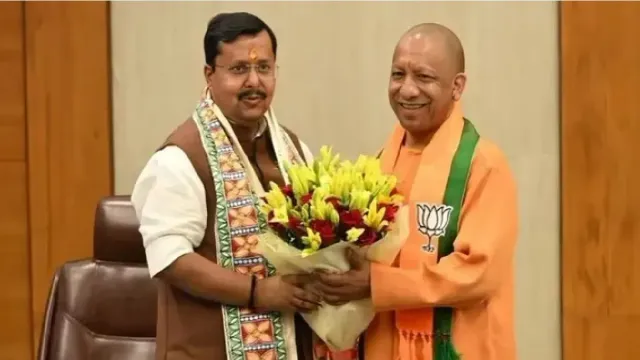
- BJP announced eight Rajya Sabha candidates for Uttar Pradesh.
- Selections focus on social engineering and caste balance strategy.
- Candidates represent OBC, Dalit, Brahmin, Thakur, and women voters.
Jagran State Bureau, Lucknow | The Bharatiya Janata Party on Monday announced the names of eight candidates for the Rajya Sabha seats in Uttar Pradesh. The ruling party keeps two factors in focus while picking candidates for the Upper House ahead of the crucial UP Assembly elections in 2027. BJP attempted to boost organisational strength and strike a caste balance in the poll-bound state.
The BJP's Rajya Sabha picks aim to woo OBC, Dalit, Brahmin, Thakur, and female voters. Some candidates have rich organisational experience, while others are popular names in their communities. The choice of candidates highlights the BJP's social engineering strategy.
Who Are BJP Candidates For UP Rajya Sabha Elections?
Dharampal Singh Lodhi, Radhakant Ojha, Prakash Pal, Vidyasagar Sonkar, Gopi Krishna Pandey, Priyanka Singh Rawat, Ram Pratap Singh Chauhan, and Shruti Gangwar were among those named in the candidate list, released by the BJP on Monday.
BJP Eyes Non-Yadav Backward Classes
The ruling party's move to select Dharampal Singh and Prakash Pal is a clear move to woo the non-Yadav backward classes ahead of the key polls. Pal is the state president of the Bharatiya Janata Party (BJP) Backward Classes Front (OBC Morcha) in Uttar Pradesh. Sing has a long organisational background and was a full-time organisational office bearer for the BJP before taking up regional and state-level leadership. Singh and Pal's nomination is seen as a move to counter the Samajwadi Party's PDA (Backward, Dalit, Minority) campaign, which is a big challenge for the ruling party ahead of the assembly polls.
Shruti Gangwar’s Nomination Aims Three Factors
Similarly, Shruti Gangwar’s nomination appears to be part of this social engineering strategy. By sending Shruti, the daughter of Jharkhand Governor and senior party leader Santosh Gangwar, to the Rajya Sabha, the BJP has attempted to simultaneously send a message of increasing women’s representation in the Upper House, generational change, and outreach to the Kurmi community. The move is also significant in the context of the regional equations of Bareilly-Rohilkhand.
#WATCH | Bareilly, Uttar Pradesh: BJP Rajya Sabha candidate, Shruti Gangwar says, "I extend my heartfelt gratitude to our central leadership — Prime Minister Modi; our National President; our Central Organization Secretary, BL Santhosh; and our state leadership—our Chief Minister Yogi ji... This is not just a major responsibility entrusted to me; it is a responsibility bestowed upon all women—upon Nari Shakti as a whole. Entrusting me with such a significant responsibility proves that our party and our respected leaders—including PM Modi, who speaks of 'women-led development' and women's leadership—truly walk the talk. By including the names of two women in this list, they have demonstrated the pivotal role women play in the country's progress and in taking the nation forward..."
— ANI (@ANI) October 5, 2026
Attempts To Appease Dalit society
The BJP has also ensured Dalit representation through the nomination of Priyanka Singh Rawat and Vidyasagar Sonkar. Rawat belongs to the Pasi community and has a strong political presence in the Barabanki region. Sonkar, a senior Dalit leader of the party from the eastern UP district of Jaunpur, has been associated with the BJP organisation for a long time. Through these two nominations, the party is seeking to broaden its voter base among the Dalit community.
BJP Also Includes Brahmin Candidates
The ruling party also considered the representation of of the Brahmin community in the candidate list. The BJP picked Radhakant Ojha and Gopi Krishna Pandey. Another candidate, Ram Pratap Singh Chauhan, represents the Thakur community. He plays key roles in the party organisation.
Voting For Rajya Sabha On Oct 16
Meanwhile, the Election Commission stated that October 6 is the last date for filing nominations and scrutiny will be held on October 7. The candidates can withdraw their nominations till October 9. Voting will be held from 9 am to 4 pm on October 16, followed by counting of votes on the same day.
(With Jagran.com Inupts)