
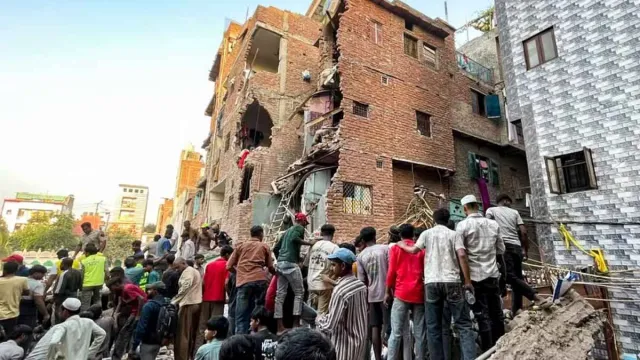
- Five lives lost in New Seemapuri building collapse tragedy.
- MCD and DUSIB blame each other for enforcement gaps.
- Illegal multi-storey construction on tiny plot violated norms.
Seemapuri Building Collapse: A day after a multi-storey building collapse in New Seemapuri claimed five lives, the tragedy has exposed severe enforcement gaps as the Municipal Corporation of Delhi (MCD) and the Delhi Urban Shelter Improvement Board (DUSIB) point fingers at each other over municipal violations.
At least five people, including children, died, and eight others were injured in the incident. The tragic incident comes on the heels of a series of deadly building collapses across the capital in recent months.
What authorities are saying
The New Seemapuri area falls under the DUSIB rather than the MCD. DUSIB is a specialised nodal agency under the Government of the National Capital Territory of Delhi (GNCTD) that began operations in 2010. It is tasked with improving living conditions, infrastructure, and housing policies for marginalised urban populations, specifically slums and Jhuggi Jhopri.
According to the DUSIB Act, the board has the authority to officially designate dilapidated areas that lack essential civic services as "slums".
While local DUSIB officials agreed that the collapsed structure was built illegally, they argued that the agency’s responsibility is limited to providing land to eligible families. They maintained that the MCD cannot shirk its duty to regulate construction.
The structure stood on a congested plot measuring just 25 square yards. Under municipal guidelines, a plot of this size is entirely unsuited to support a multi-storey high-rise, yet the owner had expanded it into a four-to-five-storey building.
Meanwhile, the MCD said that the 20-to-25-year-old building stood in a jhuggi-jhopri area managed by DUSIB, placing it outside the MCD's official responsibility and sparking an inter-agency blame game.
The MCD noted that the building violated several norms, rising multiple storeys high despite its tiny footprint. According to the civic body, neighbours reported that cracks had appeared in the structure following an earthquake and that the owner was in the process of vacating it. This has sparked fresh questions about why such a structure was allowed to exist and which agency should be held accountable.
Ongoing enforcement drives
Following the high-profile collapse in Satya Niketan, the MCD has continued its city-wide enforcement drive against dangerous buildings, unauthorised constructions, and violations of the Master Plan of Delhi (MPD) and building bylaws.
On October 5, 31 demolition actions were carried out across all 12 zones, 5 properties were sealed, and 7 demolition orders were issued. The MCD stated on Monday that unauthorised construction and norm violations will not be tolerated within its jurisdiction. Field officials have been directed to maintain strict vigilance and take necessary action against violations in accordance with the MPD, building bye-laws, and other relevant regulations. This enforcement drive will continue across all 12 zones.
In recent months, a series of fatal collapses has drawn intense scrutiny. A five-storey paying guest building collapsed in Satya Niketan on September 6, killing seven people, and a five-storey residential building collapsed in south Delhi’s Saidulajab area on May 31, crushing an adjacent canteen structure and killing six people.