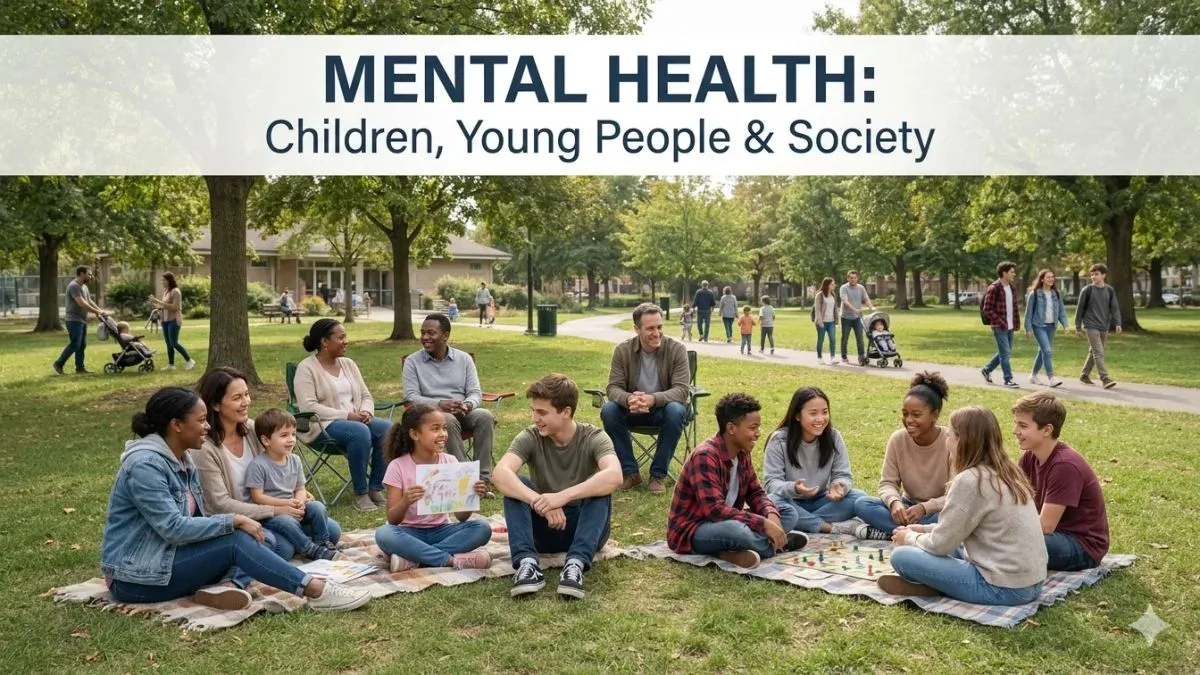
- Household stress deeply impacts children's mental well-being.
- Early signs include behavioral changes among children and young people.
- Parents, schools, and accessible mental health services are crucial for support.
How we feel, think, learn, and treat others is all determined by our mental health. A household where children and adults engage in a healthy dialogue, discussing their anxieties and problems, is a place of psychological safety and emotional resilience. It is a place where burdens are shared rather than carried alone.
However, when families face financial struggle, job loss, conflict, or an uncertain future, stress seeps in and affects children. Even though children fail to understand the real reason behind the struggle, they tend to absorb the worry and tension in the air.
Recent reports also show how a family’s environment dictates a child’s emotional quotient. Roughly one in seven teenagers globally are now living with a mental health disorder, as per the World Health Organization. The 2026 findings from the Children’s Commissioner further highlight that financial insecurity and household instability are primary drivers of youth distress.
Recommended For You
Also Read: Bengaluru Power Cut On Nov 24: BESCOM Announces Outage On Tuesday; Check Affected Areas, Timings
How Do Financial Stress And Family Conflicts Affect A Child?
Dr. Jonaki Mukherjee, educator, author of five books, and speaker, believes family conflicts affect children in more than one way. “Children may not know what a bill costs, but they know when a home has grown tense. They hear an argument through a closed door and wonder if they have done something wrong. Some become anxious or quiet; others grow angry or find it hard to concentrate,” she said.
Having over 27 years of experience in education, Dr. Mukherjee further explains that for young children, it becomes easy to divert from the topic by plainly saying, “This is an adult problem. You are safe, and it is not your fault. Conversely, the older children need logical explanations without stressing them out.
What Are The Early Warning Signs Of Emotional Distress?
Children and young people often lack the vocabulary to articulate their emotional distress or anxiety. One has to read their frequently changing behavioral patterns to identify any mental health disorders. Rather than explicit complaints, they may become silent or lose interest in things they once liked.
Dr. Mukherjee said, “A talkative child falls silent; a cheerful one loses interest in games or friends. Sleep, appetite, schoolwork or behaviour may change, and headaches or stomach aches may become frequent. Rather than scolding, sit beside the child and ask gently what has been troubling them”.
How Can Parents Break The Cycle Of Emotional Distress?
Children with any sort of mental health disorder often feel isolated by fear of judgment, making parental empathy their most vital weapon. All they need during that time is an honest reassurance, open dialogue, and a parent who can help them look ahead.
Discussing a few ways parents can deal with children under mental stress, Dr. Mukherjee elaborated, “Children with any sort of mental health disorder often feel isolated by shame or fear of judgment, making parental empathy their most vital lifeline. By replacing stigma with patient listening and consistent reassurance, parents can interrupt the cycle of silent distress and build a home where seeking help feels safe.”
How Can Schools Help Children Dealing With Stress?
Apart from home, children spend the most time in schools with peers and teachers. Integrating trained counsellors and equipping teachers to deal with youth mental health will be beneficial before academic or emotional challenges escalate.
Highlighting its significance, the expert said, “. A teacher may notice the child who suddenly sits alone, misses school or seems afraid of a classmate. One thought to add: Children do not need adults who are never worried or never wrong. They need adults who notice when something hurts, listen without shame, and show them that help can be found”.
Making Youth Mental Health Services Affordable and Accessible
Mental health services are still a long shot when it comes to affordability and accessibility. In India, counselling needs to be available closer to where people reside through schools, colleges, workplaces, and primary health centres. Online sessions by trained professionals can be a real game-changer for people living far away.
Therapies in the workplace must be made mandatory, where employees can speak freely to a trained professional in their own language.
Deploying mobile walk-in clinics, youth hubs, and peer-led community spaces will further bridge the gap for rural, remote, and marginalized youth who lack local specialists.