

The year 2024 marks a momentous beginning for the Hindu community globally. On January 22, Ayodhya will witness the grand consecration of the Ram Mandir, while on February 14, Abu Dhabi will host the inauguration of the first Hindu temple, the BAPS Mandir. Located about 2,700 kilometres from India, the BAPS Mandir, symbolising faith, culture, harmony, and civilisation, nears completion in its final phase. Prime Minister Narendra Modi and BAPS leader Swami Ji will jointly inaugurate the temple.
Brahmavihari Swami talked about the unique characteristics of the BAPS temple in a special interview with Gujrati Jagran. The excerpts from the interview provide a glimpse of the abode of divinity- the BAPS Hindu temple.
An honour for 1.25 billion countrymen: PM Narendra Modi
In 1997, Swami Maharaj envisioned a temple in Abu Dhabi, now taking shape 26 years later. Prime Minister Narendra Modi laid the foundation in 2015, and on February 11, 2018, unveiled the BAPS Swaminarayan Temple's miniature model in Dubai's Opera House. During the ceremony, PM Modi expressed gratitude to the Crown Prince for providing space for Indians to build the temple, calling it an honour for 1.25 billion countrymen. Recently, Ishwarcharan Swami and Brahmavihari Swami invited PM Modi to inaugurate the Abu Dhabi temple on December 27.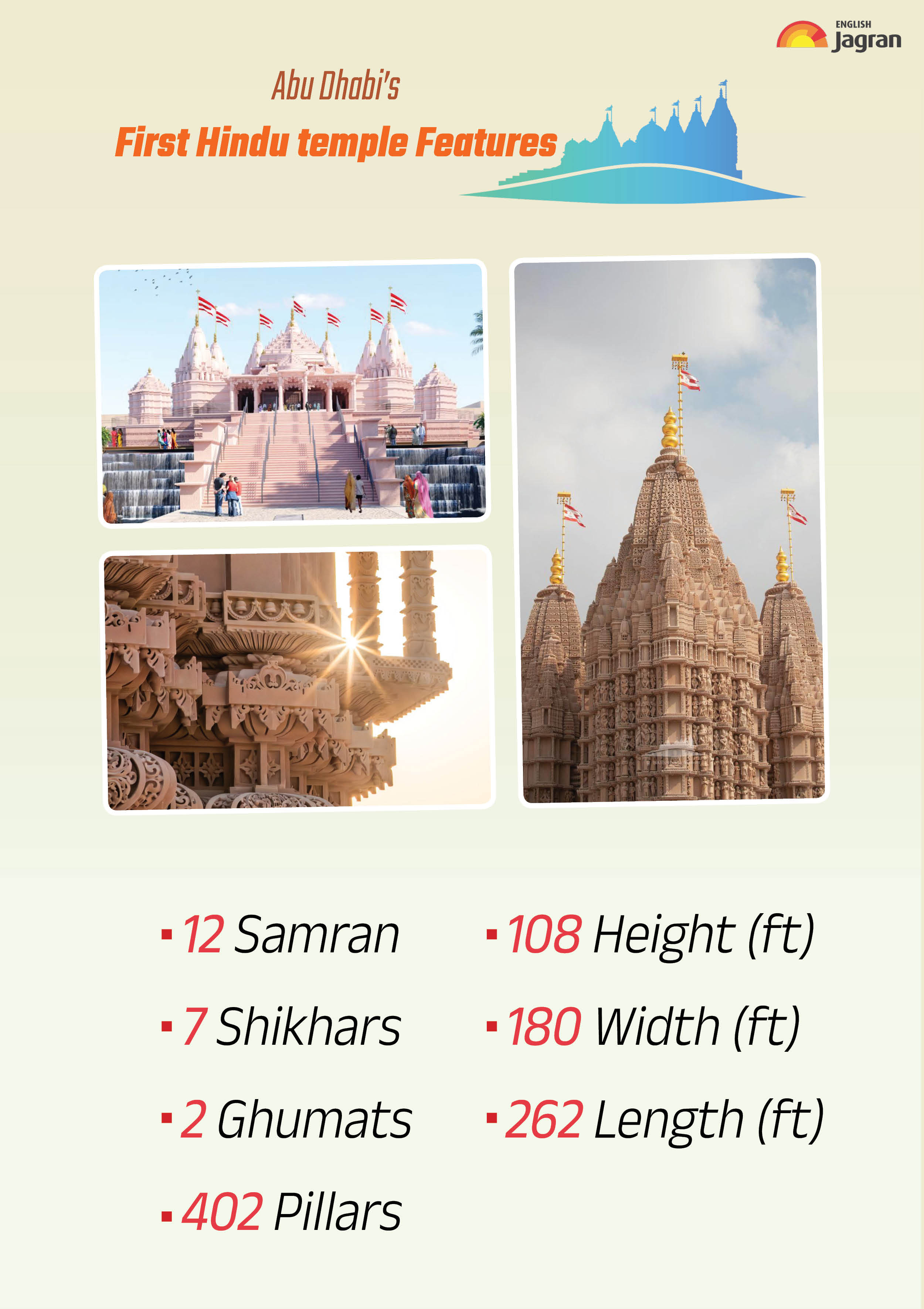
"The Shikharas (spires) of the temple depict the artistry of scriptures"
Brahmavihari Swami said, "Essentially, the entire temple is a single-level structure. No temple in this style has been built in the past 700 years, similar to temples like Khajuraho. Mandovar forms its pinnacle. Additionally, it has seven spires, presenting an almost pyramidal or rhombic shape when viewed. According to Hindu iconography and scriptures, this temple's standards are similar to other temples. The artwork in this temple depicts the entire Ramayana on the spire of Lord Rama. The artistic representation of the Shiva Purana is on the spire of Lord Shiva, and between the spires of Radha-Krishna and Jagannathji, there is artwork depicting the stories of Bhagavatam, Mahabharata, and Jagannath Ji. Furthermore, the spire of Lord Swaminarayan details the life of Lord Swaminarayan. The life stories of Lord Tirupati Ji and Padmavati are depicted on their spires, while the spire of Lord Ayyappa portrays the life story of Lord Ayyappa."
"Incorporating the eternal values of Sanatan Dharma"
The entire temple stands as a manifestation of these principles, according to Brahmavihari Swami. The temple's architectural brilliance is a visual representation of the core values of Sanatan Dharma. Every aspect seems to encapsulate the essence of our heritage, with idols depicting revered spiritual leaders and narratives from Indian mythology. The temple also encompasses 14 diverse civilisations, harmonising Maya culture, Arabian heritage, and European civilisation. Two domes within the temple symbolise celestial beings in one and the harmony of Earth, water, air, and sky in the other."
Marble and black granite statues made after extensive research
Brahmvihari Swami said, 'In the temple, idols of Purushottam, Radha-Krishna, Ram Darbar, and Shiva's family are made of marble. The idols of Padmavati and Tirupati are made of black granite, crafted by sculptors from the Tirupati temple in South India. Additionally, the idol of Jagannathji is made of cast metal, following strict procedures under the supervision of the king in Jagannathpuri. The Ayyappa idol is made of metal and is installed in the Sabarimala temple. After a year of research, all the idols to be installed in the temple are made by devotees."
"The First Scriptural Temple Where Scientific Data is Available"
Brahmavihari Swami further noted that approximately 100 sensors have been installed in the temple's foundation, and more than 350 sensors are placed throughout the temple in conjunction with its construction. These sensors provide scientific data on three aspects, including earthquake activity, temperature variations, and pressure changes. This marks the first temple of its kind to incorporate scientific data.
"Will take more than 3 hours to explore the entire premises"
Brahmavihari Swami mentioned, "If devotees visit the temple and explore the entire premises, it will take more than an hour. Reading about each event will take almost three hours."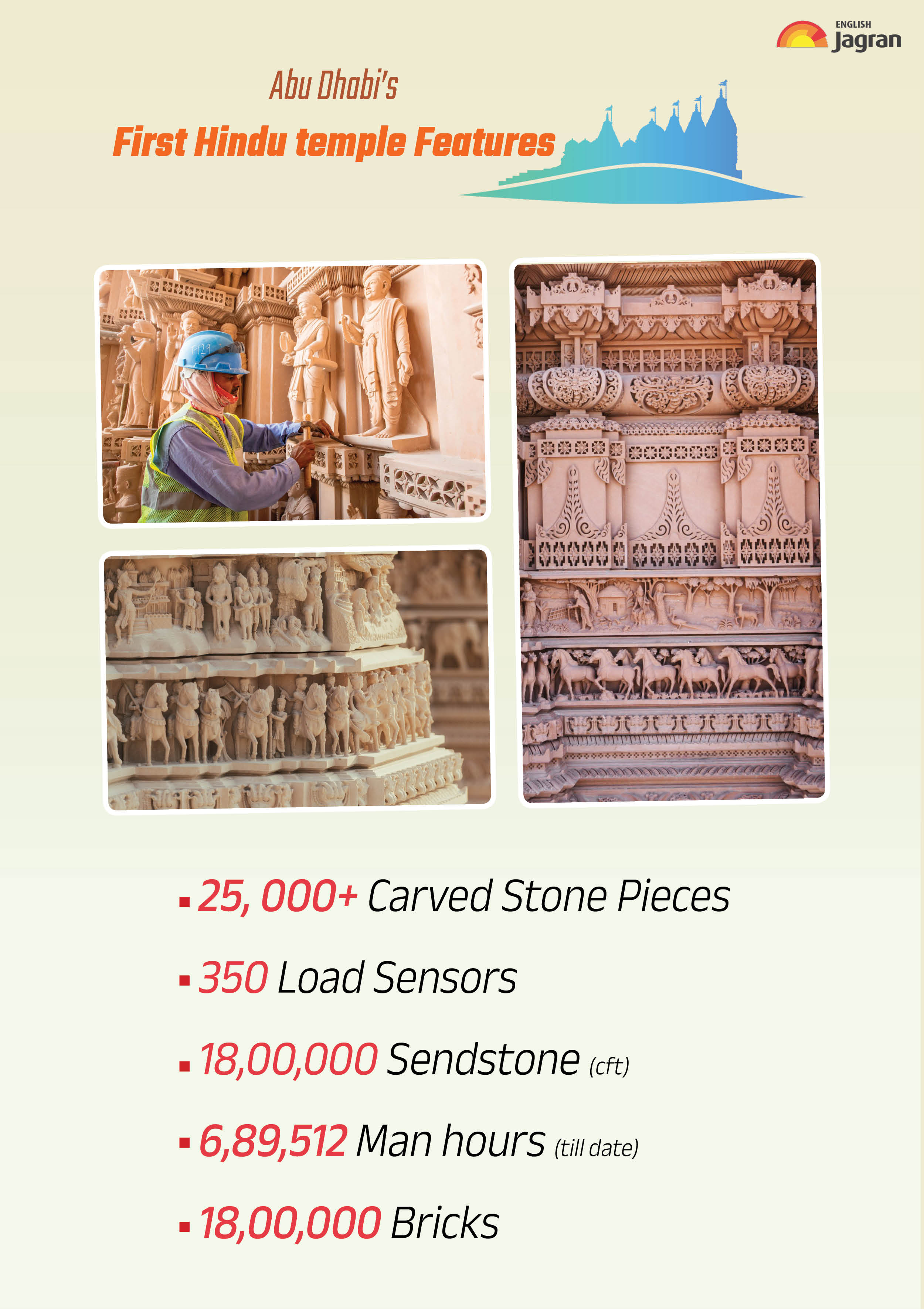
"The waters of three rivers - Ganga, Yamuna, and Saraswati - will flow"
Brahmavihari Swami said, "The temple and its surroundings are distinct entities. The temple's design aligns with the traditions set by all saints. Following this, discussions were held with Vipulbhai Somapura, who traditionally organized everything. Additionally, BAPS has a planning cell that collaborated to design the temple. The temple features sculptures of various animals like cows, lions, horses, camels, parrots, peacocks, etc. The surroundings are considered spiritual, with surrounding structures having a mystical blend and appearing to emerge from the ground. Furthermore, the waters of the three rivers—Ganga, Yamuna, and Saraswati—will flow here. Prime Minister Narendra Modi and saints will perform the first consecration of this sacred water."
Wooden boxes recycled to make tables and chairs
Brahmvihari Swami said, "In the food court within the temple premises where tents are set up in the desert, tents have been set up there. All Indian cuisines will be available there. This food court is called environment-friendly because the temple stones were brought in wooden boxes. So, the unused wooden boxes have been recycled. Wood was taken from the boxes and tables and chairs were made from it."
"Temple will stand for 1,000 years"
Swami Brahmavihari stated, "Natural materials have been used in the construction of the temple. Anything made of metal deteriorates after 100 or 150 years. We haven't used any steel or iron. Only stones have been utilized, and even in the foundation, we haven't employed steel. By the grace of God, we found stones while digging the foundation. The sand used in the temple construction is chlorine and sulfur-free. Due to all these factors, the temple will stand for more than a thousand years. Thus, no iron or steel has been used anywhere in the entire construction and structure of the temple."