
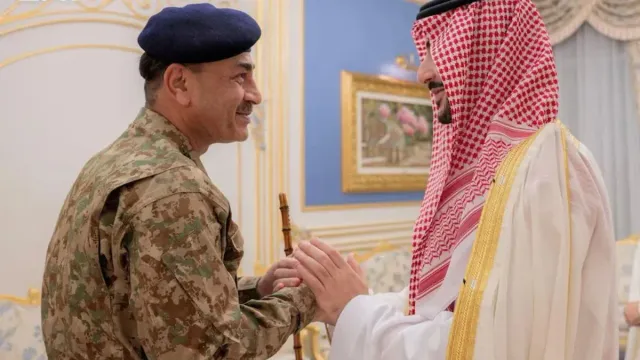
- Pakistan deploys forces to Saudi Arabia without parliamentary approval.
- Highlights military's increased grip on foreign policy under Asim Munir.
- Deployment follows defence pact amid Houthi attacks on Saudi Arabia.
Eleven years after Pakistan's parliament voted to keep the country out of a Saudi-led intervention in Yemen in 2015, Islamabad has agreed to rapidly deploy more forces to Saudi Arabia without a parliamentary vote, highlighting the military's grip on foreign policy under Field Marshal Asim Munir.
On Monday, a defence pact Pakistan signed with Saudi Arabia and Turkey in August was invoked for the first time, as the kingdom faces escalating attacks from Yemen's Iran-backed Houthis.
Munir's rise to power
Constitutional changes last year had put Munir in command of all three services until 2030, with lifetime rank as field marshal and immunity from criminal prosecution. Analysts say the deployment signals the growing power of the military at home, where jailed former prime minister Imran Khan's party is marching on Islamabad, accusing the army of dominating politics - an accusation the army denies.
"There were times in the past when Pakistan's parliament would vote not to send troops, and the military would abide by that decision. But it's a different era now," said Michael Kugelman, a resident senior fellow for South Asia at the Atlantic Council.
Pakistan' silence on sending military in Saudi Arabia
Pakistan's information ministry said the alliance "has gone through all necessary government procedures" but did not say whether the cabinet or parliament was involved, calling details of the deployment "a matter of operational confidentiality."
It's not clear if Pakistani troops will take part in operations against the Houthis, who are backed by Iran. Pakistan is actively engaged with Tehran in its role as a mediator in the US-led war on Iran, but if Islamabad gets involved in directly fighting the Houthis, that could rupture relations.
The Houthis declared a ban on Saudi shipping in July and have since struck tankers and oil facilities.
Last week, the Saudi-led coalition in Yemen said the militant group had hit a power station in Medina that supplies electricity to the Prophet's Mosque - a claim the Houthis denied.
After an emergency meeting in Riyadh that Munir attended with Saudi and Turkish counterparts, the three countries condemned attempted attacks on Mecca and Medina and said they would "provide the agreed military forces and capabilities and ensure their rapid deployment" in line with each country's "national legislation".
They gave no troop numbers, missions, command arrangements, costs or duration.
In 2015, when Saudi Arabia asked for Pakistani troops, warplanes and ships for its Yemen campaign, the then-Pakistan government put the request to parliament, which unanimously resolved to stay neutral while pledging to defend the kingdom's territory and holy sites.
A reinforcing cycle
Analysts say the difference from 2015 is political, not legal: the country's constitution gave the federal government control and command of the armed forces then, as it does now. But even when democratic governments have been in power in Pakistan, the military has been in control of areas like defence and foreign relations. Munir is widely acknowledged to be more powerful domestically than any of his predecessors.
The ruling Pakistan Muslim League-Nawaz and its ally, the Pakistan Peoples Party, did not respond to requests for comment. Zulfi Bukhari, a spokesman for Imran Khan's Pakistan Tehreek-e-Insaf party, did not say whether the party backs the deployment, but said the issue should be debated and decided with "political acumen".
The Mecca Joint Defence Agreement, whose text has not been released, builds on a 2025 Saudi-Pakistani pact under which Pakistan had sent about 8,000 troops to the kingdom by May, Reuters reported.
Prime Minister Shehbaz Sharif's government passed the constitutional changes, and his spokesperson Mosharraf Zaidi has credited "the trust and symbiosis between the field marshal and prime minister" for diplomatic gains.
Andreas Krieg, an associate professor at King's College London, said what he called a "reinforcing cycle" was in place: foreign partners were treating Pakistan's army as indispensable, which strengthens its claim at home.
Partners "do not create Pakistan's civil-military imbalance, but they can reward it," he said. However, he added, a system with weak counterweights is "good at entering commitments and worse at correcting them once costs emerge".
(With inputs from Reuters)