

Veteran actor Nana Patekar died on October 8, 2026, at age 75. He suffered a cardiac arrest at his residence in Goa. He left behind nearly five decades of Hindi and Marathi cinema.
Nana gave acclaimed performances, won several national awards, and played some of the most memorable characters. But alongside that, he left a legacy: a meme language for a generation that was barely old enough to remember when many of his films were released.
From Uday Shetty’s ‘Control Uday’ in Welcome, the viral Krantiveer monologue to the Wajood household-chores clip, his scenes have repeatedly found new audiences online.
How Nana Patekar Became A Meme Icon Of Gen Z
Long before Instagram reels and WhatsApp stickers were a thing, Nana had already perfected a recognisable way of speaking. The pauses. The sudden changes in volume. The clipped delivery. The stare before a line lands.
And years later, his dialogues became the vocabulary of today’s generation.
For instance, Nana Patekar’s role in Krantiveer was one of Hindi cinema’s most intense characters. He delivered a politically charged monologue that was designed to shake the audience.
Decades later, clips from the film acquired a completely different afterlife online.
The famous “Aa gaye meri maut ka tamasha dekhne” moment has been repeatedly recognised as a meme rather than a fierce part of the original film.
Another frequently shared line from the film is Patekar’s confrontation over communal violence: “Yeh Musalman ka khoon, yeh Hindu ka khoon…” The scene remains one of the film’s most remembered sequences.
Nana Patekar’s “Ek machhar saala aadmi ko hijda bana deta hai” from Yeshwant has also found a second life as a meme, with the dramatic line being used online for situations where a seemingly small problem leaves someone completely helpless.
View this post on Instagram
‘Control Uday, Control’: Nana Patekar’s Biggest Meme Moment
If Gen Z has one Nana Patekar character permanently stored in its meme vocabulary, it is Uday Shetty from Welcome (2007).
He played the short-tempered brother opposite Anil Kapoor’s Majnu Bhai. His most recognisable meme comes from the scene in which Uday tries to control his anger, repeating: “Control, Uday. Control.”
Then there is “Seh lenge thoda”, another Uday line that has developed a life of its own.
Moreover, his comic frustration with Majnu also produced meme-ready lines. “Saala jalta hai tu mujhse, Majnu!” is used online whenever someone is jokingly accused of jealousy.
Similarly, the scene around Uday’s disastrous attempt at acting produced the absurd “Aloo le lo, kaanda le lo” sequence, which has been repeatedly clipped, shared and turned into reaction content.
That is why Uday Shetty continues to work so well on Instagram, X, WhatsApp and meme pages. His dialogues become a meme for everyday situations.
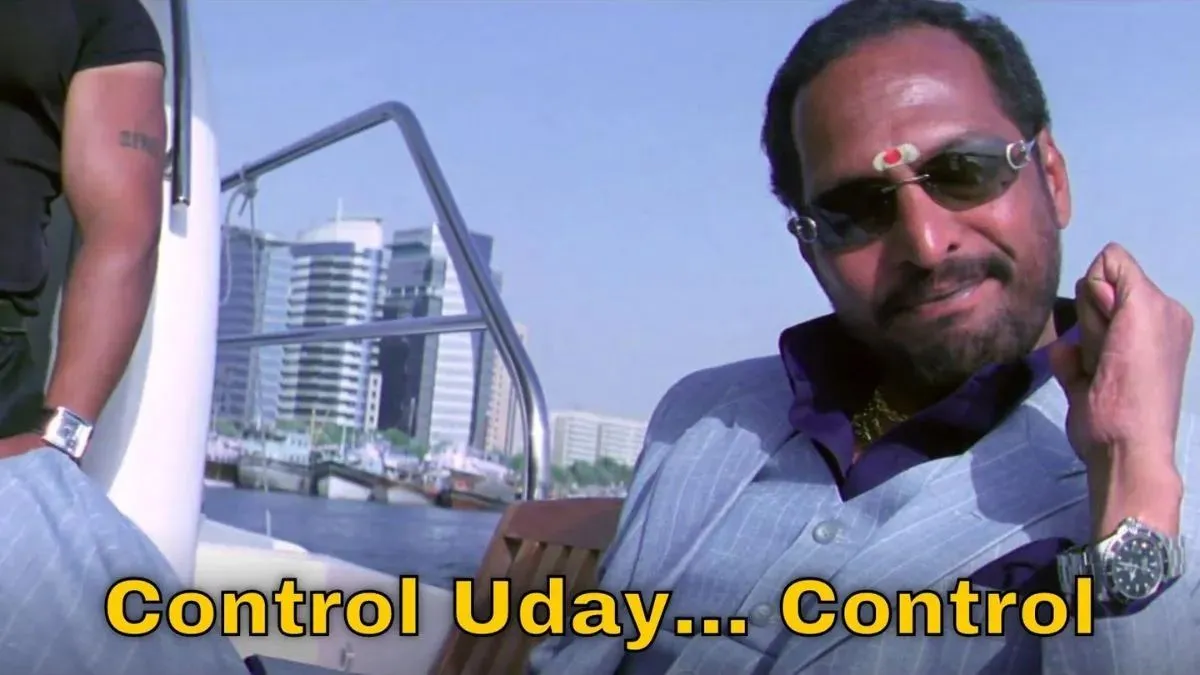
Nana Patekar 'Uday Shetty' Made Him Meme Icon (Image Credit: Instagram @tcx.official)
The Wajood Clip That Became A Household Meme
A scene from his 1998 film Wajood became a popular meme template years after the film’s release. In the scene, his character Malhar is shown making tea, washing dishes and sweeping the floor while being scolded by his father.
The clip was widely repurposed online for jokes about household chores and everyday frustration.
Why Nana Patekar’s Scenes Worked So Well As Memes
Nana Patekar has an advantage that very few actors do: his face, voice and delivery can communicate a complete reaction in a few seconds.
Anger, disbelief, frustration, sarcasm, helplessness or overconfidence were all part of his acting vocabulary, making his scenes unusually easy to turn into GIFs, reels and reaction memes.
That is particularly suited to Gen Z’s visual, reference-heavy way of communicating. A familiar Nana Patekar expression can replace an entire sentence, while a line such as ‘Control Uday, control’ or ‘Seh lenge thoda’ instantly signals a mood.
ALSO READ: 'Nana Patekar Slapped Me For Real': Madhoo Shah Says She Hit Him Back On Yeshwant Sets
Nana Patekar’s legacy goes far beyond his films, but his unforgettable expressions, voices and dialogues have given Gen Z a way to rediscover him through memes and reels. Which Nana Patekar dialogue or meme do you still use?
FAQs
Q1. When did Nana Patekar die?
A1. Nana Patekar died on October 8, 2026, at the age of 75, after suffering a cardiac arrest at his residence in Dona Paula, Goa.
Q2. What is Nana Patekar’s most famous meme dialogue?
A2. ‘Control Uday, control’ from Welcome is his most widely used meme dialogue.
Q3. Which Nana Patekar movies are popular in memes?
A3. Welcome, Krantiveer and Wajood are among the films most frequently referenced through his viral dialogues and scenes.