
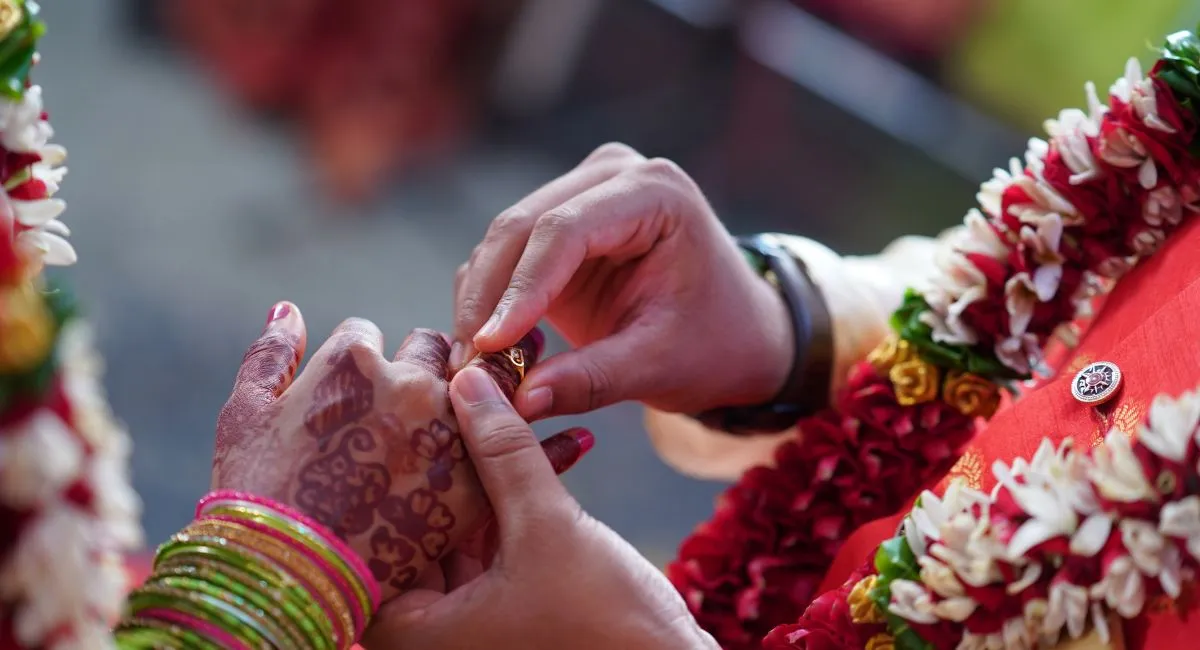
- Families in Vadia village arrange early marriages for girls.
- Aimed at protecting daughters from generational prostitution cycle.
- NGOs support mass marriages and alternative livelihood initiatives.
Marriage, a phase of life that comes with great responsibility and major changes, is usually associated with adulthood. But in a village in Gujarat’s Banaskantha district, families have used marriage as a way to protect their daughters from being pushed into prostitution, with some girls engaged as young as seven.
Vadia, located around 200 km from Ahmedabad, is home to around 750 people, most of them from the traditionally nomadic Sarania community. For generations, women in the village have been pushed into the sex trade, while men often acted as intermediaries who brought customers.
Over time, some families began arranging early engagements and marriages to ensure their daughters would not enter the trade. An unwritten practice developed in the village that girls who were engaged or married would not be pushed into prostitution.
ALSO READ: Gujarat Man Performs CPR, Saves Snake After It Faints In Chemical-Contaminated Water | WATCH
Engaged At 11, Determined To Study
A 19-year-old woman from Vadia, whose mother and grandmother were involved in prostitution, is now studying nursing. She was engaged at 11 and married at 18.
“I grew up seeing my father and uncle getting men for both my mother and grandmother till they became 'unfit' to serve the visitors' desires. My mother told me that it wasn't that she was forced into it, but it just felt like the norm which everyone followed due to poverty. My mother was not even sure if my father was my biological father because of this,” she told PTI on condition of anonymity.
“But my mother decided that she would not let me be pushed into this… I was engaged at 11 in a collective ceremony and married at 18,” she added.
Mass Marriages Begin In 2012
The shift became more visible in 2012, when NGOs persuaded families to stop pushing their daughters into the trade. Mass marriage ceremonies were organised, alongside efforts to improve education and create alternative sources of income.
Mittal Patel, founder of Vicharta Samuday Samarthan Manch, said, “Persuading the families to stop pushing their daughters into this trade, confronting pimps who move around disguised as moneylenders, sensitising society on this heinous practice, compelling parents to educate their children, organising the first-ever mass marriage ceremony in the village, convincing 90 of 160 families to give up the trade… the change has been anything but easy.”
The initiative has also included efforts to revive borewells and lakes, improve agricultural land and provide interest-free loans to families seeking alternative livelihoods.
Child Marriage Remains A Concern
Activists have raised concerns over child engagement and marriage, which remain legally prohibited when they involve children. Families in Vadia, meanwhile, continue to view marriage and education as ways to break a cycle that has persisted for generations.
The village still faces social stigma because of its history, but several families say they are determined to ensure their daughters have opportunities beyond the trade that once shaped the lives of generations of women.
(With PTI inputs)