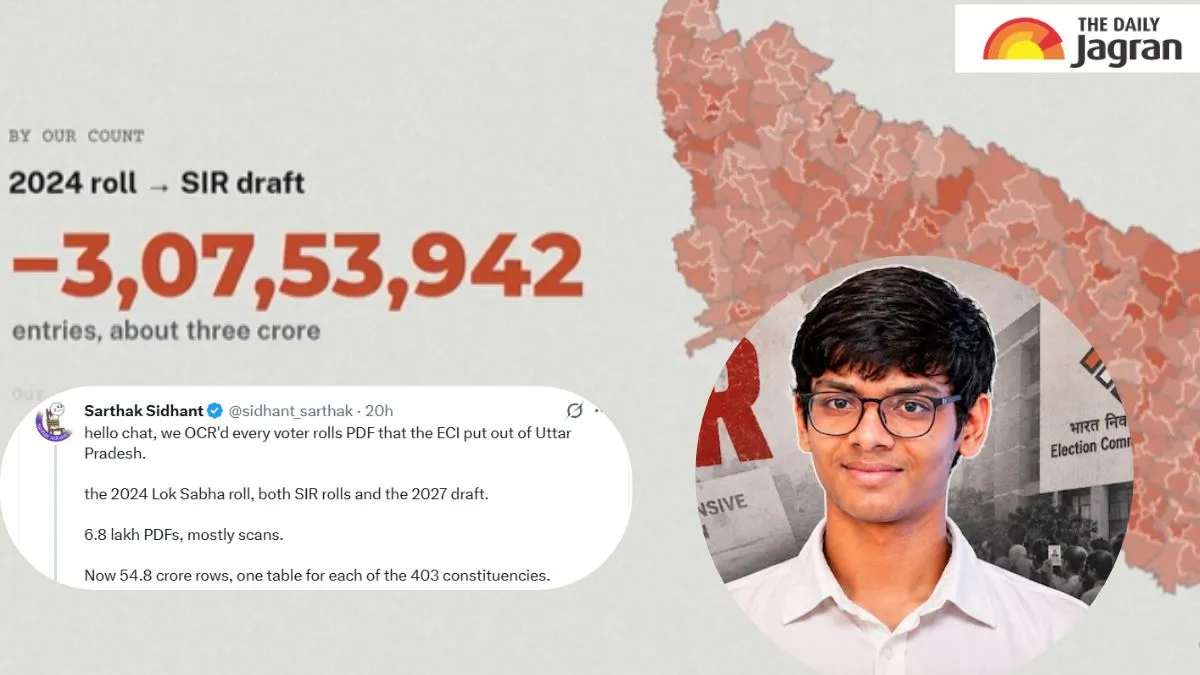
- Sarthak Sidhant digitised 6.8 lakh UP voter roll PDFs.
- Converted 54.8 crore image-based entries into searchable data.
- Enhances public access and scrutiny of electoral information.
The 18-year-old student name Sarthak Sidhant from Ranchi, who earlier found discrepancies in the OSM process of the CBSE, is now knocking at the doors of the ECI. This time his task was to render the millions of voter roll documents searchable.
In a tweet on Tuesday (November 24, 2026), Sidhant tweeted that he and his team had converted 6.8 lakh PDF files of the electoral rolls of Uttar Pradesh, most of which are scanned and thus image-based documents, to searchable data. It involved 54.8 crore voter roll entries in 403 Assembly constituencies of Uttar Pradesh.
hello chat, we OCR'd every voter rolls PDF that the ECI put out of Uttar Pradesh. the 2024 Lok Sabha roll, both SIR rolls and the 2027 draft. 6.8 lakh PDFs, mostly scans. Now 54.8 crore rows, one table for each of the 403 constituencies. Free to download, Link below. https://t.co/eyW6CwNi3R
— Sarthak Sidhant (@sidhant_sarthak) November 24, 2026
But the challenge that Sidhant addressed was of equal importance to the scale of the issue. The ECI had uploaded the rolls on their website, but most of it was in scanned PDFs. Searching for a name, checking an entry, or comparing lists from different revisions would mean downloading each file individually and checking through it. Sidhant’s contribution helped make the unsearchable searchable.
Recommended For You
From CBSE's OSM to ECI's SIR: A Pattern of Public Scrutiny
But then again, this is not Sidhant's first brush with the issue of accessible information being difficult to analyze.
His previous probe had originated from his personal displeasure in May following the CBSE Class 12 results. Spotting some discrepancies in his grades, he had access to scans of his answer sheets that were marked, and proceeded to study the OSM system adopted by the CBSE.
By the time of late May and early June, he had begun comparing the changes made in successive CBSE tender documents, especially in relation to the criteria of eligibility, technical requirements, and other parameters for selecting the contractor of the digital evaluation process.
He submitted a seven-page analysis of his findings to the Parliamentary Standing Committee on Education chaired by Digvijaya Singh, a Congress member of parliament, on June 2. And then on June 26, he published an open database of government procurement of 1.66 crore transactions from the Central Public Procurement Portal maintained by the Centre.
On being included in TIME100 Next India 2026 on November 20, he got international attention. Just four days later, he launched the voter rolls project.
6.8 Lakh PDFs, 54.8 Crore Rows: Inside the Project
The project covers four sets of electoral rolls: the roll used in the 2024 Lok Sabha elections, the draft and final rolls prepared during the SIR, and the 2027 draft roll.
Explaining the scale on X, Sidhant wrote that his team ran OCR on every Uttar Pradesh voter roll PDF the ECI released, processing 6.8 lakh files, most of them scans, into 54.8 crore rows of data. The records are organised into tables for each of the 403 Assembly constituencies.
OCR turns written text on scanned images into readable data for computers, thus enabling a computer to read the written text and figures rather than reading the page as an image file. With millions of files, the difference will be huge. For a voter, scholar or journalist to be able to do this, they would need to locate the appropriate constituency and polling booth, and then open the PDF and read its pages manually. This structured information allows search, comparison and analysis.
The publicly downloadable files have been made secure; all personal information such as names, names of family members, EPIC number and house number have been replaced with keyed-hash tokens. The data can be validated against the original ECI PDFs.
"Doing the Government's Work": Reactions Pour In
The significance goes beyond convenience. Electoral rolls underpin the voting process, and changes made during an SIR can affect a citizen's right to vote.
The initiative comes amid wider Opposition demands for machine-readable rolls, led by Lok Sabha Leader of the Opposition Rahul Gandhi. Uttar Pradesh's Chief Electoral Officer's office had introduced searchable, downloadable PDFs for the 2027 draft roll on November 17. Sidhant's effort goes further by consolidating four roll sets and processing hundreds of thousands of documents into a single dataset.
Congress MP Gaurav Gogoi of Jorhat backed the work on X on Tuesday, calling it long, painstaking and essential, and saying democracy is served when citizens stay vigilant and public institutions face scrutiny.
I support the work done by @sidhant_sarthak . It is long and painstaking but essential. Democracy is served when citizens are vigilant and the institutions meant to serve the public are under scrutiny.
— Gaurav Gogoi (@GauravGogoiAsm) November 24, 2026
Senior journalist Pankaj Pachauri also praised the effort, calling it true public service and saying the team was doing work the ECI would not dare to do.
ALSO READ: UGC-NET December 2026: City Intimation Slips To Be Released Today At ugcnet.nta.nic.in; Details
For Sidhant, the project continues a journey that began with questioning his own exam results. From scrutinising CBSE's digital evaluation system to opening up procurement records and now electoral data, he has used technology to make public information more accessible and institutions more accountable. At 18, the Ranchi teenager is carrying that idea from the classroom to the institutions that shape public life.