

As protests triggered by a deepening economic crisis continue to roil Iran, leaving more than 500 people dead, US President Donald Trump has warned that Washington could intervene militarily if Tehran continues its crackdown on protesters. If tensions escalate into open conflict, naval power would play a decisive role, particularly in the Persian Gulf and the strategic Strait of Hormuz.
The United States Navy is the world’s most powerful maritime force by a wide margin. As a founding member of NATO, the US maintains a blue-water navy capable of operating across the globe. It fields 11 nuclear-powered aircraft carriers, supported by guided-missile cruisers, destroyers, attack submarines, and logistics vessels that enable sustained operations far from home waters.
The US also operates more than 50 nuclear-powered submarines, many armed with cruise missiles and advanced torpedoes, giving Washington unmatched undersea dominance. Combined with real-time intelligence, satellite surveillance, and joint operations with the Air Force and Marines, the US Navy is designed to overwhelm adversaries quickly.
ALSO READ: Pakistan Set To Sell JF-17 Thunder Fighter Jets To Bangladesh: Why Is It Concerning For India?
Iran: Asymmetric Naval Warfare
Iran cannot match the US ship-for-ship, but its naval doctrine focuses on asymmetric warfare. The Islamic Revolutionary Guard Corps Navy (IRGC-N), established after the 1979 revolution, operates alongside Iran’s regular navy and specialises in swarming tactics using fast attack boats, naval mines, and anti-ship missiles.
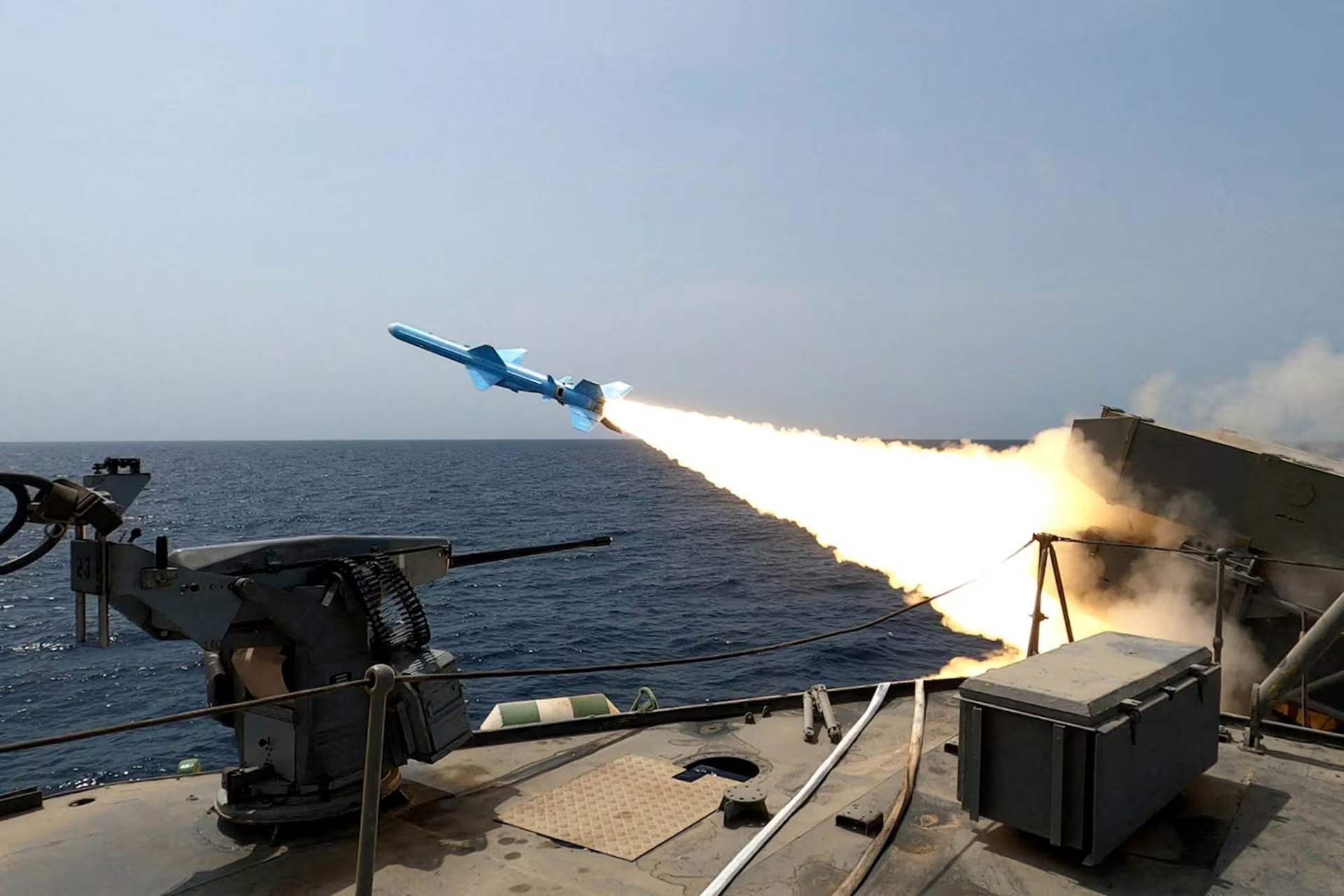
An Iranian missile is launched during a military exercise in Iran (Image credits: Reuters)
From coastal batteries and mobile launchers, Tehran can deploy anti-ship cruise missiles, drones, and ballistic missiles capable of targeting vessels in the Persian Gulf. Iran has repeatedly demonstrated its ability to harass commercial shipping and foreign warships, raising the risk of disruption to global energy supplies through the Strait of Hormuz, a chokepoint for roughly a fifth of the world’s oil trade.
Iran’s navy also operates diesel-electric submarines and midget subs suited for shallow waters, complicating detection and increasing the threat of surprise attacks.
US vs Iran: Military Power Snapshot
| Category | United States | Iran |
|---|---|---|
| Military Strength | Global power with advanced, integrated forces | Regional power focused on deterrence |
| Infantry Weapons | M4/M4A1, SIG Sauer M7, M249, M240, Javelin | Mostly domestic and legacy Russian/Chinese systems |
| Artillery & Rockets | M777, M109 Paladin, HIMARS | Large rocket and artillery inventory |
| Missiles | Precision-guided missiles across all domains | 3,000+ ballistic missiles, incl. Shahab, Kheibar |
| Drones (UAVs) | High-end ISR and strike UAVs | Large, low-cost combat drone fleet |
| Air Power | Modern fighters, stealth bombers (B-2, B-52) | Older jets, limited domestic fighters |
| Naval Power | Aircraft carriers, Aegis-equipped warships | Coastal force, fast boats, anti-ship missiles |
| Air Defense | Aegis, layered missile defence | Indigenous SAM and radar systems |
| Nuclear Capability | Full nuclear triad (ICBMs, SLBMs, bombers) | No declared weapons; enrichment capability |
| Strategic Focus | Global deterrence & power projection | Asymmetric warfare & missile deterrence |
Who Holds The Edge?
In a direct naval confrontation, the advantage overwhelmingly favours the United States. Its carriers, submarines, air power, and missile defenses far exceed Iran’s capabilities. The US could control sea lanes, strike Iranian naval assets, and impose a blockade if required.