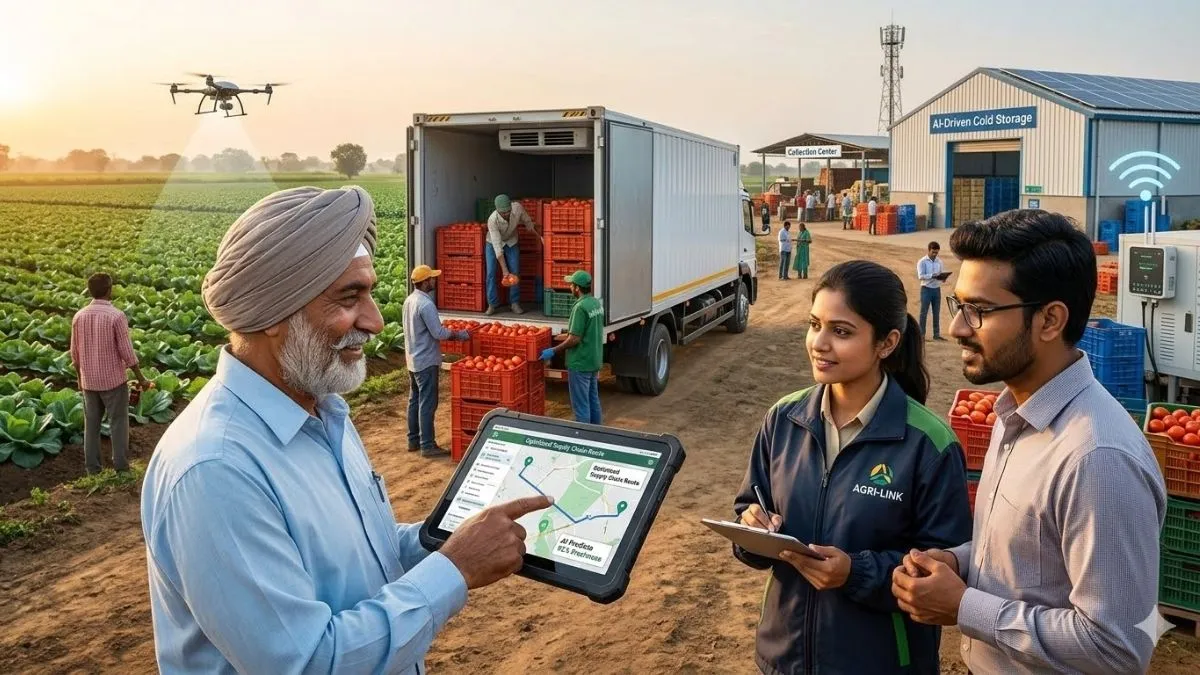
- AI significantly reduces transaction times and operational inefficiencies.
- The company achieved profitability and processed billions in farmer payments.
Artificial intelligence is rapidly reshaping operational activities in all sorts of organised or unorganised sectors across the globe. Be it banking, education, production, transport or other industries, AI is driving efficiency and innovation. The food supply chain sector is not untouched, and AI possesses much potential for transformation in the agricultural food supply chain. Traditionally, this critical journey from farm to factory has been plagued by deep-seated inefficiencies: fragmented aggregation, opaque pricing, cumbersome manual paperwork, and logistical bottlenecks that often lead to significant value erosion.
How AI Is Reshaping the Food Supply Chain Industry
In today’s scenario, AI is quietly rewriting operational rules in the Agri-Food Supply Chain Sector by automating complex backend processes—from real-time bid matching to rapid payment reconciliation. Additionally, the technology is bridging the gap between harvest and market significantly. As applications of AI tools and IoT systems scale further, they will be doing more than just saving time, as the technology will be fundamentally redefining the economics of food distribution.
In an exclusive interaction, FarMart Co-Founder and CEO Alekh Sanghera explains how AI is transforming the less visible but critical journey from farm to factory.
How is AI transforming the food chain industry?
- India grows enough food to feed itself and much of the world. Yet a significant part of its value can disappear between the farm and the factory due to fragmented aggregation, delayed payments, opaque pricing, manual paperwork and inefficient logistics. Alekh Sanghera believes artificial intelligence can address some of these long-standing gaps.
Recommended For You
How will it help Farmers?
- For farmers, much of this technology may remain invisible. But if it makes food move faster, reduces waste and gets money through the supply chain sooner, its impact could be anything but invisible.
How Does AI Play a Crucial Role At FarMart?
FarMart's AI capabilities operate across two layers. The first is a Voice AI system that can call more than 1,000 suppliers within a few minutes, in Hindi, to clarify price details, capture crop availability, understand intent and take order requests. In a supply chain where many participants may never interact with a keyboard-based interface, the company sees voice as a primary discovery mechanism for a large part of its network.
The second layer involves agentic workflows that execute post-transaction operational tasks. Documents including loading slips, weighbridge receipts, goods received notes, buyer quality reports, invoices and transport bills are reviewed by AI across 17 verification parameters. Truck registrations are checked in real time against the government's Vahan database, while potential forgery patterns are flagged automatically. Invoices and e-way bills are generated in seconds using GST APIs, with human teams reviewing exceptions rather than every transaction.
The platform connects 3.2 lakh registered suppliers with more than 600 registered buyers across 11 states and over 40 food categories. Its buyers include Britannia, Godrej, Parle, Patanjali, Cargill and Roquette. In 2025, FarMart says it facilitated Rs 23.4 billion in direct payments to 4.8 lakh farmers.
Unlike agritech businesses that rely heavily on inventory holding or credit distribution, FarMart operates an asset-light model. It owns no warehouses or trucks. Its business is built around matchmaking, quality verification, logistics facilitation, compliance automation and financial settlement — services that are now increasingly run through AI.
Also read: GAIL, ITC Hotels Spotlight Industry Solutions For Cleaner Air At Next Gen Bharat 2026 Conference.
Does AI Increase Efficiency For You?
The difference can be seen in the time taken to complete everyday tasks. A supplier KYC process that previously took one hour now takes five minutes. Bid matching has fallen from two hours to 15 minutes, while creating an invoice and e-way bill, which earlier took two hours, can now be completed in five seconds.
Supplier payment settlement that previously required one to two days now takes around 2.5 hours for more than 50% of transactions. Collection reconciliation, which earlier took 10 to 15 days, now takes five seconds for 30% of transactions.
Ques: Take Me Through the Company's Finances
- FarMart, a Gurugram-based agri-food commerce platform founded in 2015, closed FY26 with a gross order value of ₹2,879 crore, up 50% from Rs 1,961 crore in FY25. The company turned EBITDA profitable in Q4 FY26, its first full profitable quarter, and has sustained that profitability into FY27. Its annualised revenue run rate exiting Q1 FY27 stands at Rs 4,500 crore.
Sanghera said that the bigger advantage may lie not in the AI models themselves, but in the data generated through years of transactions. More than 100,000 documents have been processed across 20 commodities and 11 states, creating information around pricing, quality rejection rates, buyer repayment patterns, truck waiting times, fulfilment delays and fraud signatures.
“This dataset does not exist anywhere else in Indian agri-commerce. And it gets better with every transaction - the moat compounds with scale, not just with time,” Sanghera says. “The AI we have today is built on a dataset that took years of field operations to create.”