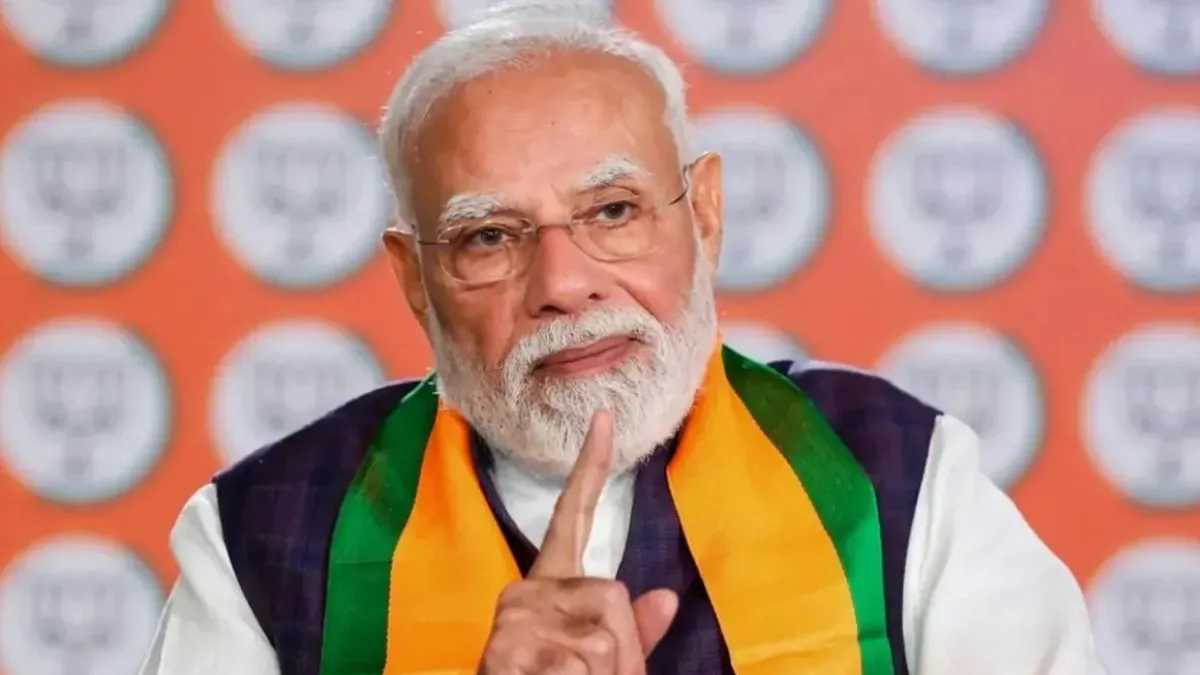
- Modi said Opposition parties cannot stop greater women's representation.
- He reiterated his commitment to the country's Nari Shakti.
- Modi said Opposition parties cannot stop greater women's representation.
Prime Minister Narendra Modi on Saturday asserted that his government will definitely implement reservation for women in the Lok Sabha and state assemblies and that parties opposing it will not be able to stop it.
In a video message on X, Modi also said the government remains committed to fulfilling the promise made to the country's "Nari Shakti".
We had made a promise to our Nari Shakti and we remain committed to fulfilling it... https://t.co/ZT3TK71Psh
— Narendra Modi (@narendramodi) November 28, 2026
"Our resolve to empower Nari Shakti remains unshaken. I want to assure every woman in the country that we will definitely eliminate and remove every obstacle that comes in the way of women's reservation," he said.
The prime minister said the spirits of those supporting the women's reservation bill are high, "our courage is unbreakable, and our resolve is steadfast".
"The parties opposing women's reservation will never be able to stop the country's "Nari Shakti" from increasing its participation in Parliament and the state assemblies. It is just a matter of time," he said.
ALSO READ: Karthigai Deepam Row: PM Modi Welcomes Supreme Court Directive To Light Lamp At Deepathoon
Delimitation Bills Linked To Women's Reservation Implementation
The Cabinet has cleared three revised draft legislations, including the Constitution (132nd Amendment) Bill, 2026, and the Delimitation (Second) Bill, 2026. The proposals are aimed at facilitating the implementation of women's reservation alongside a restructuring of legislative representation.
Under the proposed changes, the maximum strength of the Lok Sabha would increase to 850 seats, including up to 815 representatives from states and 35 from Union territories.
The draft legislation also proposes increasing parliamentary representation by 50 per cent across states and Union territories. The maximum permitted strength of state Legislative Assemblies is also set to rise from 500 to 650 members.
Another key provision concerns the distribution of seats among states. The revised allocation is proposed to remain unchanged until 2051, with the 1971 Census continuing to serve as the basis for determining the relative share of parliamentary seats among states.