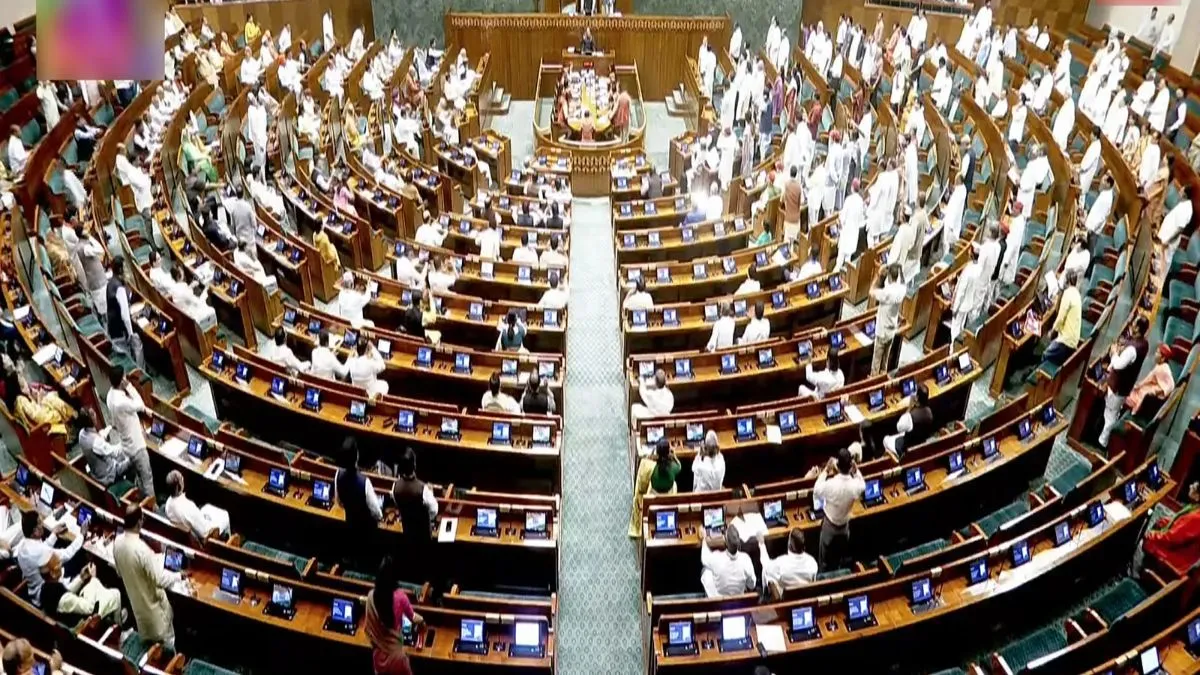
- Lok Sabha seats projected to increase to 815-816.
- 33% women's reservation quota targeted for 2029.
- Uniform 50% seat increase maintains federal balance.
Ahead of a special parliamentary session starting November 30, the Union Cabinet on Friday approved amendments to the proposed delimitation legislation that propose a uniform 50 per cent increase in Lok Sabha seats from 543 to around 815 within a constitutional ceiling of 850, while extending the freeze on inter-state seat proportions until 2051.
The expansion is expected to reshape India's parliamentary arithmetic across four major fronts: north-south federal balance, Lok Sabha-Rajya Sabha power dynamics, the 33 per cent women's reservation quota, and voter-to-MP ratios.
ALSO READ: Sharad Pawar's NCP, With 9 MPs, To Support NDA On Delimitation Bill In Parliament Special Session
North-South Federal Balance
Rather than redistributing seats strictly on recent population growth, a formula southern states argued would penalise demographic control, the revised framework proposes a uniform 50 per cent increase across states. It also extends the freeze on inter-state seat distribution, originally anchored to the 1971 Census, by another 25 years until 2051, keeping broad regional proportions intact.
Under the 50 per cent expansion model cited by Press Information Bureau releases, major states see proportional gains, with combined representation for the five southern states rising from 129 to 195 seats and maintaining roughly a 24 per cent share of the House.
Recommended For You
State / Region | Current Seats | Projected Seats (50% Expansion) |
Uttar Pradesh | 80 | 120 |
Maharashtra | 48 | 72 |
West Bengal | 42 | 63 |
Bihar | 40 | 60 |
Tamil Nadu | 39 | 59 |
Karnataka | 28 | 42 |
Andhra Pradesh | 25 | 38 |
Kerala | 20 | 30 |
Telangana | 17 | 26 |
Lok Sabha-Rajya Sabha Power Dynamic
The proposed Constitution (131st Amendment) Bill raises the maximum Lok Sabha limit from 550 to 850 (up to 815 seats for states and 35 for Union Territories), while leaving the Rajya Sabha's ceiling unchanged at 250.
Expanding the Lok Sabha to roughly 815 shifts the Lok Sabha-to-Rajya Sabha seat ratio from about 2.2:1 to 3.3:1. Analysts note that a larger Lower House increases its dominance in joint parliamentary sittings and lowers the relative weight of Rajya Sabha members in Presidential and Vice-Presidential elections.
33% Women's Reservation Ahead Of 2029 Polls
Under the 106th Constitutional Amendment Act of 2023, the 33 per cent reservation for women in the Lok Sabha and state legislative assemblies was linked to delimitation following the next census.
By delinking immediate boundary redrawing from the upcoming census and using the 2011 Census to adjust constituency boundaries within states, the proposals aim to clear the path for rolling out the women's quota by the 2029 General Elections. In an 815-member House, a one-third quota would translate to roughly 270 seats reserved for women.
Voter-To-MP Ratios
Because current Lok Sabha constituencies still reflect the 1971 Census, MPs represent far larger populations than when those boundaries were set. A 50 per cent increase in seats eases that load by lowering the average number of voters per MP.
While inter-state seat shares remain frozen, a Delimitation Commission would redraw constituency boundaries within each state based on 2011 Census population shifts, adjusting urban-rural representation and updating Scheduled Caste (SC) and Scheduled Tribe (ST) reserved seats.
ALSO READ: Why Single-MP Parties Matter for NDA's Women Quota, Delimitation Push | Numbers Explained
Two-Thirds Majority Hurdle
Because raising the Lok Sabha's strength requires a constitutional amendment, the bill needs a two-thirds majority of members present and voting in both Houses of Parliament.
An earlier version of the bill fell short in the Lok Sabha in April 2026, winning 298 votes against the 352 required, making backing from opposition parties critical when the special session begins on November 30.
(With Inputs From PTI)