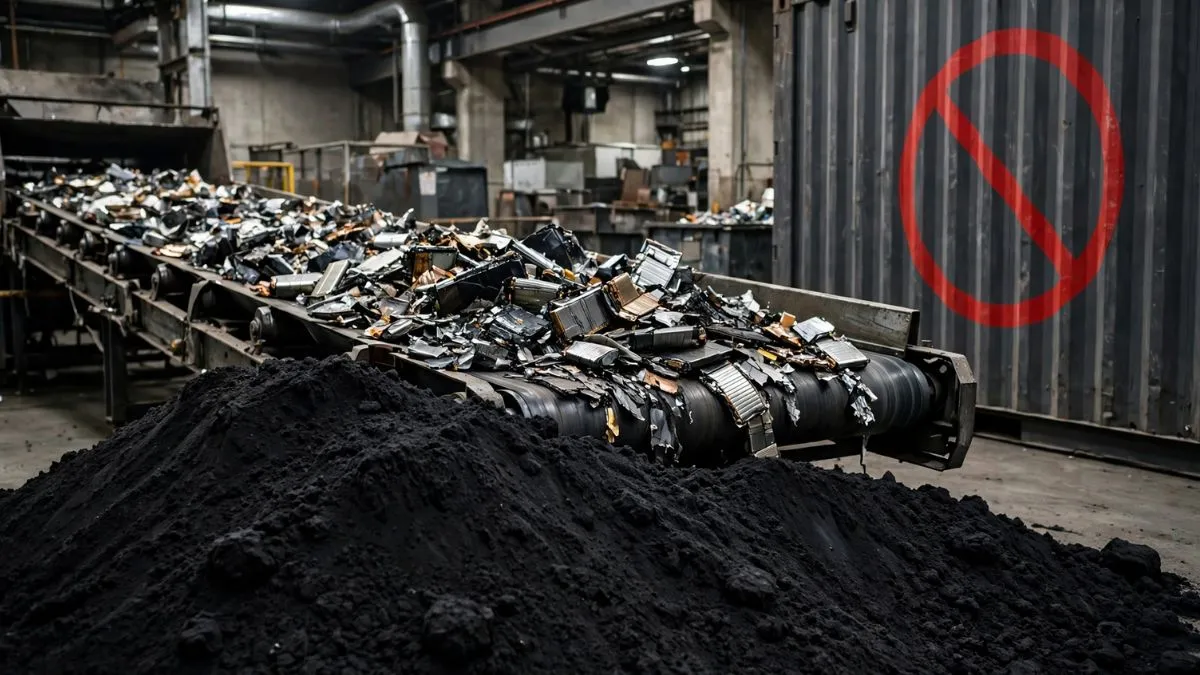
- India bans lithium-ion battery black mass export immediately.
- The move aims to boost domestic recycling and critical mineral recovery.
- The move will also reduce import dependence and support National Critical Mineral Mission.
In a major move, India has banned the export of lithium-ion battery black mass, a powdery material obtained from shredding used lithium-ion batteries and battery manufacturing waste. The move is aimed at ensuring that valuable minerals contained in this material, including lithium, cobalt, nickel, and manganese, are recovered and processed within the country instead of being sent abroad. This is seen as a big step toward reducing dependence on imported critical minerals.
What Is Black Mass?
Black mass is a dark, powder-like material produced when end-of-life lithium-ion batteries and battery manufacturing scrap are mechanically shredded and processed. It contains a mixture of materials, including graphite, lithium, nickel, cobalt, manganese, and other residues. The material is valuable as it contains several critical minerals that are essential for manufacturing batteries. It gets its dark colour from graphite, which is commonly used in battery anodes.
As black mass is not a finished product, it can't be directly used in new batteries. It acts as an important raw material for recycling companies, which processes it to recover valuable metals. Through refining methods such as hydrometallurgy and pyrometallurgy, minerals such as lithium, cobalt, nickel, and manganese are recovered. Recyclers first extract the metals either by dissolving the powder in chemical acids which is known as hydrometallurgical processing or melting it in high-temperature furnaces, known as pyrometallurgical smelting.
Recommended For You
The separated lithium, nickel, cobalt, manganese, and graphite are then purified into high-purity, battery-grade salts and chemical compounds. Finally, these refined materials are sent back to cell manufacturers to build brand-new lithium-ion batteries for electric vehicles and energy storage systems. Graphite is also extracted through this process.
Reasons Behind India's Ban
According to a press release by the Ministry of Commerce & Industry, the Directorate General of Foreign Trade (DGFT) has prohibited the export of lithium-ion battery black mass falling under ITC(HS) Code 85491400. The export policy has been changed from 'Free' to 'Prohibited', with immediate effect and until further orders.
India mainly exported lithium-ion battery black mass to advanced refining hubs in Asia, primarily China and South Korea. The main reason behind the decision is to ensure that black mass generated in India is processed by domestic recycling and refining companies. Despite the growth in India's battery recycling capacity, these facilities have not been fully utilised. One of the reasons include the inadequate availability of raw material.
In many cases, recyclers imported black mass to meet their requirement as material generated in India was exported. By restricting exports, the government now aims to ensure a steady supply of black mass to Indian recyclers. This is expected to improve the utilisation of existing facilities, encourage fresh investment, and create employment in the recycling sector, the press release noted.
Moreover, it would also reduce India's dependence on imports of critical minerals and lower foreign exchange expenditure. Lithium, cobalt, nickel and other minerals recovered from black masses are essential for electric vehicles, battery manufacturing, renewable energy storage and electronics. The decision also supports the National Critical Mineral Mission (NCMM), which includes an incentive scheme to develop recycling capacity for recovering critical minerals from secondary sources.