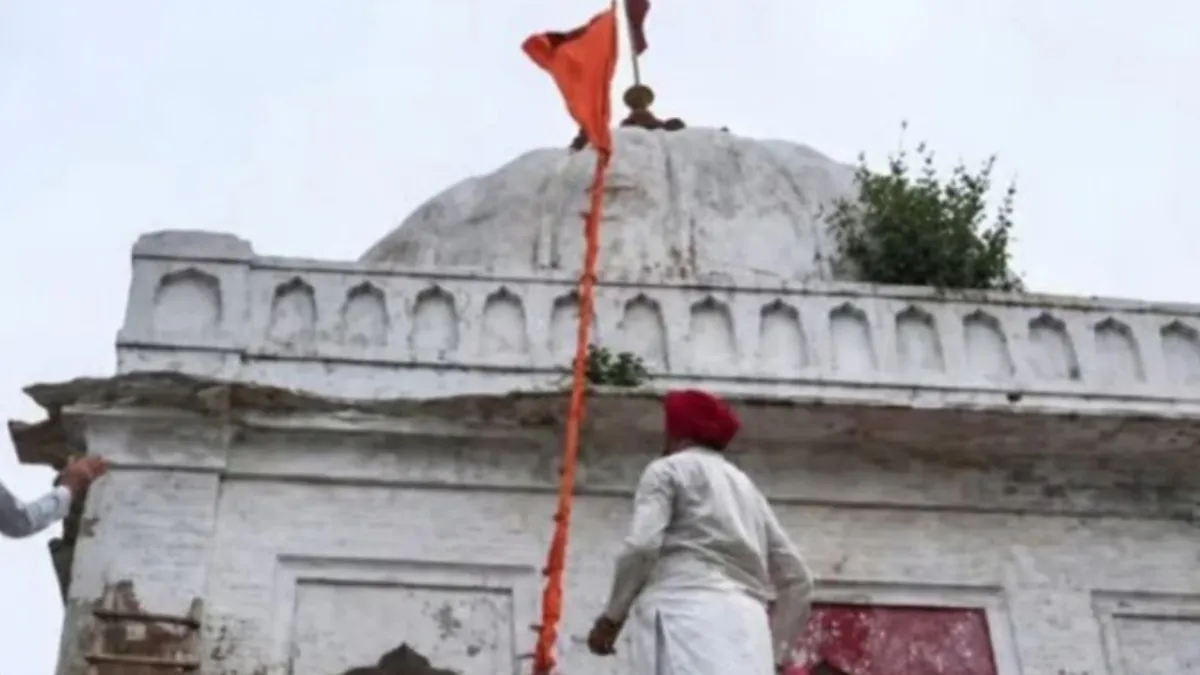
- The reopening of Lahore's historic Gurdwara marks the return of regular Sikh worship at a site.
- The Gurdwara is linked to Guru Hargobind Sahib’s three-day stay in Lahore.
- Over 50 gurdwaras in Pakistan are currently under renovation to preserve Sikh heritage.
The Chhevin Patshahi Sri Guru Hargobind Sahib Gurdwara in Pakistan's Lahore reopened after restoration on Sunday. It is a historic moment because it has been closed for worship since Partition in 1947. The Gurdwara on Temple Road was reopened after a ceremony conducted as per Sikh religious traditions. The event was attended by government officials along with Sikh community members.
Gurdwara Reopens After 79-Year Hiatus
Among the prominent attendees were the Minorities Minister of Pakistan's Punjab province and Pakistan Sikh Gurdwara Parbandhak Committee president Sardar Ramesh Singh Arora, Evacuee Trust Property Board (ETPB) Secretary Nasir Mushtaq, and other officials.
During the ceremony, Arora officially announced the reopening of the shrine for worship. More than 50 gurdwaras have been undergoing renovation, according to him. These renovations are meant to preserve Sikh heritage and offer better worship facilities for pilgrims.
Significance Of Chhevin Patshahi Sri Guru Hargobind Sahib Gurdwara
The religious and historical significance of the Gurdwara goes back to the time when the sixth Sikh Guru, Guru Hargobind Sahib, visited Lahore. He accepted an invitation from the local Sikh congregation and stayed there for three days at the residence of a devotee named Bhai Jiwan. The devotee later converted the house into a Gurdwara.
Guru Hargobind Sahib, who lived from 1595 to 1644, was seen as a warrior-saint who empowered the Sikh community to stand up against religious oppression.
Gurdwara Also Linked To Bhai Bidi Chand
According to historical accounts of the Sikh community, Bhai Bidhi Chand was a Sikh religious preacher and military commander. He came to Lahore to take back the horses seized by the Mughal governor.
Recommended For You
Bhai Bidhi Chand played a crucial role in getting those horses back. He pulled it off by slipping into different disguises- once he went around as a grass seller, and another time he showed up claiming to be an astrologer. Both times it worked, and he brought the horses safely home to Guru Hargobind Sahib.
The place saw more work done on it in 1915 when the local Sikh sangat enlarged the prayer hall. A few years later, the management shifted. There were serious complaints about Mahant Hari Singh, who had been running the gurdwara, so the sangat stepped in during 1921, took control, and set up their own committee to look after things.
In 1927, the SGPC formally took over and brought the historic shrine under its central administration. Everything changed with Partition in 1947. Regular Sikh religious life at the site came to a complete stop. People still talk about how some members of the community were killed while trying to defend the gurdwara during the violence of those days. From that point on, the gurdwara has remained closed to normal Sikh worship and gatherings.